



Published 24 July 2026
Our methodology focuses on accuracy first.
All information is researched using manufacturer data, official industry guidance, and trusted automotive sources. Where relevant, content is cross-checked against real-world vehicle maintenance practices and common customer enquiries to ensure it is both practical and accurate. Our content is reviewed regularly and updated to reflect changes in regulations, industry standards, and best practices.

Here's something that surprises people: there is no specific "supercar law" in the United Kingdom. No dedicated statute covering the hire of high-performance vehicles. No special regulatory framework governing how a Lamborghini Aventador changes hands between an operator and a hirer for a weekend.
What there is — and what creates the practical legal landscape you operate in when hiring a supercar — is a combination of existing UK motoring law, contractual obligations imposed by hire operators, and an increasingly active public and political debate about whether the current framework is sufficient.
This guide maps all three layers. By the end, you'll understand exactly what the law requires, what operators add on top of it, and what's currently being discussed that may affect the market in future.
The Legal Baseline: What UK Law Actually Says About Driving Supercars
Let's start with the foundation.
Under current UK law, most road-legal supercars fall under Category B of the driving licence framework — the standard passenger car category covering vehicles up to 3,500kg with up to 8 passenger seats. A Ferrari SF90 and a Ford Fiesta are the same licence category in the eyes of the DVLA.
This means:
- No special driving licence is required to drive a supercar on public roads
- No power-based restriction exists in UK driving law
- No formal "supercar category" exists in the licence framework
The Road Traffic Act 1988 and its subsequent amendments govern how all vehicles — including supercars — are driven on UK roads. The laws about speeding, careless driving, dangerous driving, drink driving, and vehicle insurance apply identically to a Lamborghini and a Vauxhall Astra.
What this means practically: A 26-year-old who passed their test a year ago is legally permitted to drive a Porsche 911 Turbo S on public roads. Whether a hire company will hand them one is a completely separate question — governed by the company's own eligibility criteria, not by law.
The Operator Layer: Where the Real Rules Live
The absence of specific supercar hire law doesn't mean an absence of rules. It means the rules exist primarily at the contractual level — set by hire operators based on insurance underwriting requirements, business risk management, and in some cases ethical judgement.
Here's how the most significant operator-imposed requirements compare to the legal minimum:
| Requirement | Legal Minimum | Typical Operator Requirement |
|---|---|---|
| Driving licence | Category B (standard) | Full licence, clean record |
| Minimum age | 17 (to hold a licence) | 25–30 depending on vehicle |
| Licence held for | No minimum in law | 2–5 years minimum |
| Penalty points | No formal limit for road use | Maximum 6 points |
| Serious offences | No automatic bar in law | DD, DR, TT codes typically disqualify |
| Vehicle categories | None (Category B covers all) | Vehicle-specific age requirements |
For the most powerful vehicles — Lamborghini Aventadors, Ferrari SF90s, McLaren flagships — some operators push minimum age requirements to 28 or 30 and impose stricter licence history requirements than the standard threshold.
These aren't laws. But breaching them creates two practical problems: you won't be insured, and you'll be in breach of contract. The commercial and financial consequences of either can be severe.
UK Road Traffic Laws That Specifically Affect Supercar Hirers
Every UK driver knows the basic rules. But there are aspects of road traffic law that have specific and heightened relevance when you're driving a high-performance hired vehicle.
Speed Limits
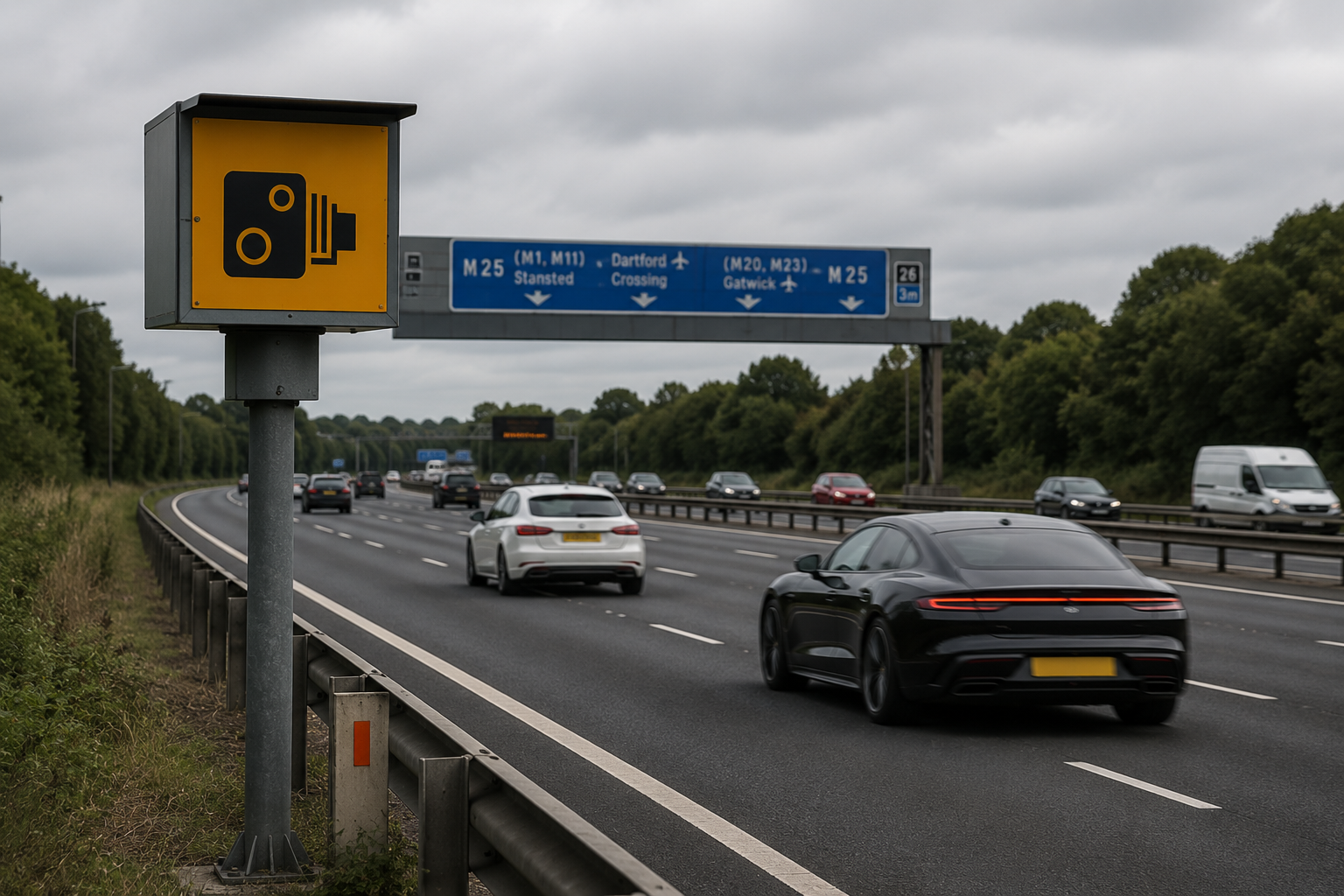
Speed limits apply uniformly to all vehicles. A Ferrari doing 120mph on a 70mph motorway is committing the same legal offence as any other vehicle — but with several additional complications:
- Speeding penalties (fines, points, disqualification) can be applied to the hirer if the vehicle is caught by a fixed camera during your hire
- The hire operator receives any penalty notices and passes them to you, usually with an administration fee added
- Multiple speeding incidents during a hire can result in prosecution
- Speed cameras are significantly more active in the UK than most European countries — the enforcement infrastructure is real
The hire operator is typically named as the registered keeper of the vehicle. Camera fines are issued to them and redirected to you. There is no practical route to avoid this.
Careless and Dangerous Driving
Section 2A and Section 3 of the Road Traffic Act 1988 define careless driving (driving below the standard of a competent driver) and dangerous driving (driving far below that standard, creating obvious risk). Both apply identically to hire vehicles.
The specific relevance to supercars:
A court assessing whether driving was careless or dangerous considers what a competent driver of that vehicle would do. Driving a 600bhp Lamborghini requires a higher level of competence than driving a family hatchback — the vehicle's capability creates higher responsibility, not lower.
Someone unfamiliar with a high-powered car who causes an accident through excess speed or loss of control may find that what they considered a minor lapse meets the legal threshold for careless driving more readily than the same behaviour in a less powerful vehicle.
Noise and Anti-Social Use
This is the area where public debate is most active. High-powered cars generate significant noise, and the use of hired supercars for what's colloquially called "showing off" — deliberately revving engines in residential areas, performing illegal street racing, making repeated passes through town centres — has attracted significant legal and political attention.
Existing UK laws that apply:
- Road Traffic Act 1988, Section 3 (careless or inconsiderate driving) covers driving that inconveniences other road users, which can include deliberate and aggressive noise-making
- Section 59 of the Police Reform Act 2002 allows police to seize vehicles used in a manner causing alarm, distress, or annoyance — including hired supercars
- Public Spaces Protection Orders (PSPOs) can be used by local councils to restrict specific behaviours in defined areas — several UK towns and cities have either implemented or discussed PSPOs aimed at antisocial supercar use
What this means for hirers: Driving a hired supercar responsibly — within speed limits, without aggressive noise-making in residential areas, without intimidating other road users — means existing law is not a concern. Using a hired car as a prop for antisocial street behaviour creates genuine legal risk.
Proposals for Tougher Supercar Hire Regulation
The UK has seen growing political pressure for tighter rules around supercar hire specifically — separate from the general road traffic framework.
What's been proposed:
- At least one MP has called publicly for "brakes on individuals renting supercars and driving recklessly on public highways" — framing the issue as one requiring targeted legislative action
- Several UK towns and cities (including some in West Yorkshire and the Home Counties) have seen proposals to use PSPOs and noise abatement orders more actively against antisocial supercar use
- Media debate about a UK equivalent to South Australia's U-Class licence (requiring additional qualifications for vehicles above a power-to-weight threshold) recurs periodically
The current position: As of 2026, none of these proposals have been enacted into law. The UK does not have a dedicated supercar hire regulatory framework, a power-based licence category, or national restrictions specifically targeting rental supercars.
The practical regulations remain: general road traffic law, operator T&Cs, and local enforcement using existing powers.
This could change. Anyone building long-term plans around the supercar hire market should be aware that tighter regulation is actively discussed — even if not currently implemented.
Taking a Hired Supercar Abroad: The Legal Requirements
Standard UK supercar hire contracts restrict the vehicle to the United Kingdom unless international use is specifically authorised in writing. Taking the car abroad without authorisation is a breach of contract that typically voids the insurance — with potentially significant legal and financial consequences if anything goes wrong.
If international travel is authorised:
| Requirement | Details |
|---|---|
| Written operator permission | Mandatory — verbal confirmation is insufficient |
| Green Card | Required for most European countries as proof of insurance |
| V5C registration document | Required in many European countries for roadside checks |
| Valid UK or international licence | Plus IDP if required in the destination country |
| Compliant vehicle insurance | Must cover the specific countries visited |
Post-Brexit, UK motor insurance provides third-party cover in EU countries as a minimum (under the Motor Vehicles [Compulsory Insurance] Regulations), but the higher levels of cover you're insured for under the hire policy may not automatically extend. Confirm the exact coverage territory with the operator before any international journey.
The practical advice: If you want to take a hired supercar to Europe — an Alpine driving trip, a weekend in Paris — raise this at the enquiry stage. Some operators accommodate it with appropriate documentation; others prohibit it entirely.
Track Use and Private Road Driving: What the Law and Contract Say
The legal position: Private land, private circuits, and airfields are not subject to road traffic law. The standard UK road traffic framework — speed limits, licensing requirements, mandatory insurance — does not apply on private land.
The contractual position: Virtually all UK supercar hire contracts explicitly prohibit track use. The language typically covers: racing, timed events, track days, off-road driving, and use on any surface not intended for public road use.
This prohibition exists because hire operators' insurance policies — which cover road use — do not extend to track use. The moment a hired car goes on a circuit, the insurance is void. Operators cannot insure for track risk at standard hire rates.
The practical consequence: If you drive a hired supercar onto a circuit, lose control, and crash it, you are personally liable for the full repair or replacement cost — not just your excess. For a Lamborghini Aventador, that could exceed £300,000.
Some specialist operators do offer dedicated track hire with appropriate cover — but these are separate products, booked explicitly, not standard hire terms extended to a different environment.
Required Documents: Legal vs Contractual
Understanding which requirements come from law and which from contract helps you prepare for any hire.
| Requirement | Source | What It Is |
|---|---|---|
| Valid UK driving licence | UK law | Legal requirement to drive any vehicle on UK roads |
| Vehicle insurance | UK law | Motor insurance is a legal requirement |
| Third-party liability insurance | UK law | Minimum level of insurance required by law — provided by the hire operator |
| Proof of identity (passport or ID) | Operator policy | No universal legal requirement, but standard hire practice |
| Proof of address | Operator policy | Contractual requirement for insurance eligibility |
| DVLA share code | Operator policy | Used to conduct licence check — not a legal obligation, but a contract requirement |
| National Insurance number | Operator policy | Used by some operators to run DVLA check |
| Credit card for deposit | Operator policy | No legal requirement — contractual |
The legal minimum for driving is: a valid licence and insured vehicle. Everything else in the list above is required by the hire operator for their own insurance and risk management purposes — but practically, you won't be given the car without them.
What Happens If You're Caught Speeding or Driving Recklessly?
In a hired supercar, the consequences of enforcement follow a clear sequence:
Fixed camera speeding:
- Notice of Intended Prosecution (NIP) issued to the registered keeper (the hire company)
- Hire company forwards the NIP to you, identifying you as the driver
- You receive the formal notice and must respond
- Penalty: fixed penalty notice (£100 + 3 points for standard offences) or court referral for serious offences
- Hire company may charge an administration fee for processing the NIP (typically £25–£75)
Careless driving (Section 3, RTA 1988):
- Fixed penalty: £100 + 3 points, or
- Court prosecution: unlimited fine, disqualification possible
Dangerous driving (Section 2, RTA 1988):
- Court prosecution: up to 2 years imprisonment, unlimited fine, mandatory disqualification
Drink driving or drug driving:
- Minimum 12-month disqualification, unlimited fine, up to 6 months' imprisonment (14 years if someone is killed)
- Hire insurance void
- Full personal liability for all vehicle damage and third-party costs
The hire company is not liable for traffic offences committed during your hire. You are, in all cases, the responsible driver.
Your Consumer Law Rights as a Supercar Hirer
UK consumer law provides protections that apply to supercar hire contracts regardless of what the operator's T&Cs say.
Key protections:
Unfair contract terms: Under the Consumer Rights Act 2015, contract terms must be transparent and fair. A hire company cannot include a clause that is fundamentally unfair or that significantly undermines your rights as a consumer — even if you signed it.
Right to clear information: Operators are required to make material terms (excess amounts, restrictions, cancellation terms) clear before you commit. Hidden charges or terms that weren't clearly communicated at the time of booking can be challenged.
Protection against fraud: Never pay the full balance or security deposit by bank transfer. Reputable operators process deposits by credit card (held as pre-authorisation). If a "company" insists on bank transfer for a deposit or won't operate from verified premises, that's a significant warning sign.
Practical advice for staying protected:
- Keep all written correspondence and booking confirmations
- Never sign a contract with blank sections — ask for completion before signing
- Pay by credit card where possible — Section 75 of the Consumer Credit Act provides additional protection on purchases over £100
- Book directly with the hire company, not through an unverified broker, for maximum protection and clear accountability
The Regulatory Landscape: Summary
Here's where the UK currently stands on laws around hiring high-performance cars:
| Aspect | Current Position |
|---|---|
| Special supercar driving licence | Not required — standard Category B suffices |
| Minimum age in law | 17 (to hold a licence) — operators typically set 25–30 |
| Power-based licence category | Does not exist in UK law |
| Track use regulations | No specific law — hire contracts prohibit it universally |
| Anti-social use legislation | Existing laws (S.59, PSPOs) apply — no supercar-specific statute |
| Proposed tougher rules | Under discussion — not currently enacted |
| Consumer protection | UK Consumer Rights Act 2015 applies |
Final Thoughts: The Law Is Straightforward; the Contract Is Where the Detail Lives
The UK legal framework for driving high-performance hire cars is, in most respects, the same legal framework that governs every car on every road. Speed limits apply. Drink driving laws apply. Insurance requirements apply.
What makes supercar hire legally distinct is the contractual layer that operators add — and the consequences of voiding those contractual terms through prohibited use, unauthorised drivers, or misrepresentation. Understanding both layers clearly means you hire confidently, drive responsibly, and arrive home with both the car and your legal position intact.
The road is yours. Within the law. And with the keys safely returned.
Ready to find a supercar hire with transparent terms and full legal clarity? Compare vehicles and operators from hundreds of hire partners across the UK with Autofusion — and book knowing exactly what the rules are.