


Published 16 July 2026
Our methodology focuses on accuracy first.
All information is researched using manufacturer data, official industry guidance, and trusted automotive sources. Where relevant, content is cross-checked against real-world vehicle maintenance practices and common customer enquiries to ensure it is both practical and accurate. Our content is reviewed regularly and updated to reflect changes in regulations, industry standards, and best practices.
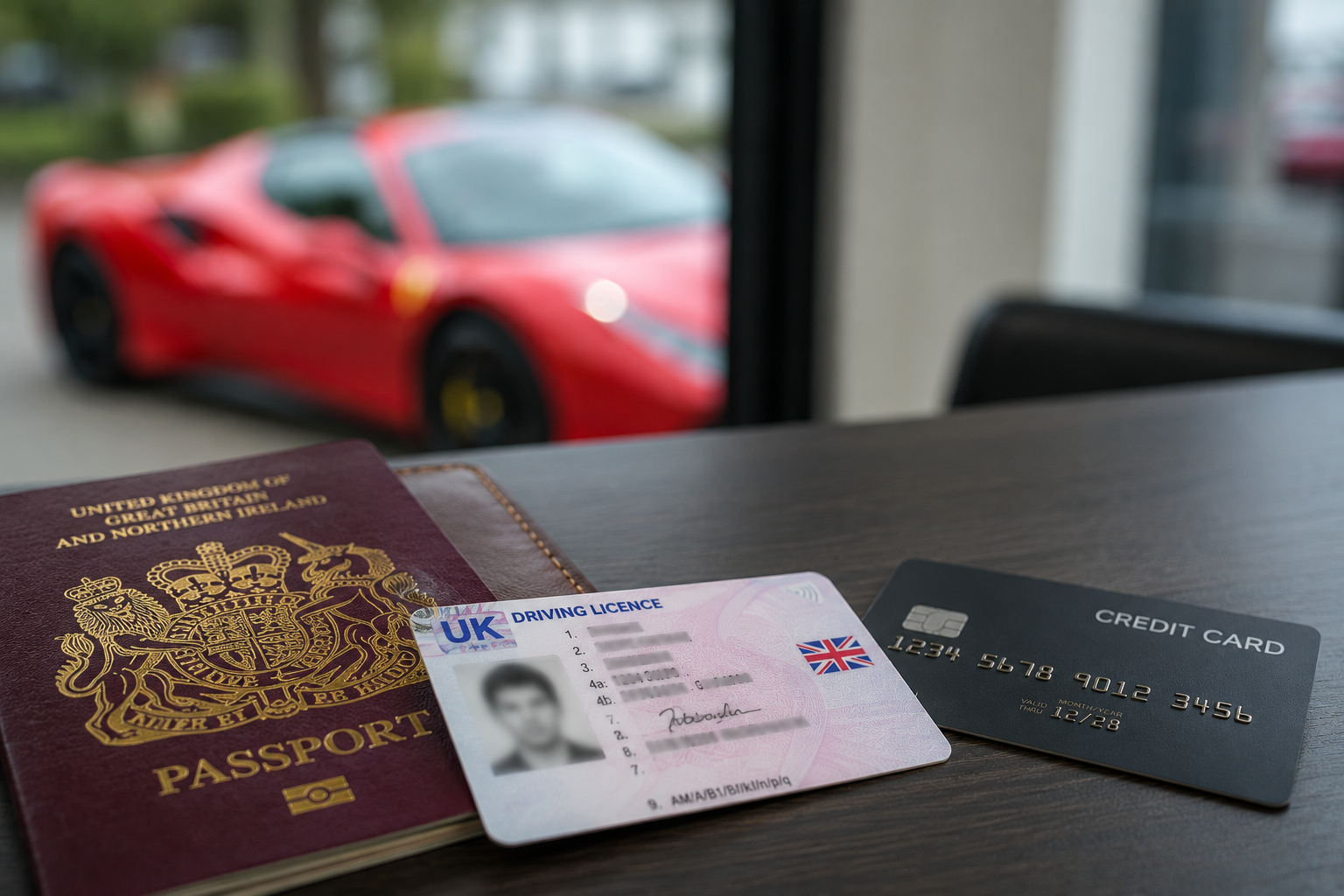
Most people who start searching for supercar hire in the UK spend their first twenty minutes looking at Lamborghinis and Ferraris. Which is entirely understandable: that's the point. But the second, more important question, the one that determines whether any of this is actually available to you, is: do you qualify?
The requirements for supercar hire in the UK are stricter than for standard car hire, and they get progressively stricter as the cars get more valuable and more powerful. A Ferrari F8 Tributo isn't insured under the same conditions as a Volkswagen Golf. The age threshold is higher, the licence history requirement is more demanding, the endorsements you can have are more limited, and the financial commitment required is more substantial.
None of this is designed to exclude people. It reflects the insurance and risk realities of handing keys for a £250,000 vehicle to someone you met twenty minutes ago. Understanding exactly where you stand before you start comparing cars saves time, prevents disappointment, and lets you plan effectively if there's a gap between where you are now and where you need to be.
This guide covers every requirement in one place: age, your driving licence, the documents you'll need, what UK law says about driving a supercar, and what to do if you don't quite meet the threshold yet.
Once you've checked these, our step-by-step guide to hiring a supercar covers the booking itself.
Age Requirements: The Short Version
Most specialist providers set the minimum age at 25 for supercars, rising to 28 or 30 for flagship models such as the McLaren 720S or Lamborghini Aventador. Performance sports cars are often available from 21 to 23. The exact threshold depends on the car and the partner's insurance, not on the law.
What this means practically: If you're 25 and want to hire an Audi R8, most specialist providers will accommodate you. If you're 25 and want to hire a Ferrari F8 Tributo from a major specialist, you may encounter age restrictions from some providers. If you're under 25, the supercar tier is largely inaccessible, but the performance sports car tier (Porsche 718, Jaguar F-Type, Audi TT RS) usually is.
For the full breakdown by model, young driver surcharges and the best cars you can hire before 25, see how old you have to be to hire a supercar.
Do You Need a Special Supercar Licence?
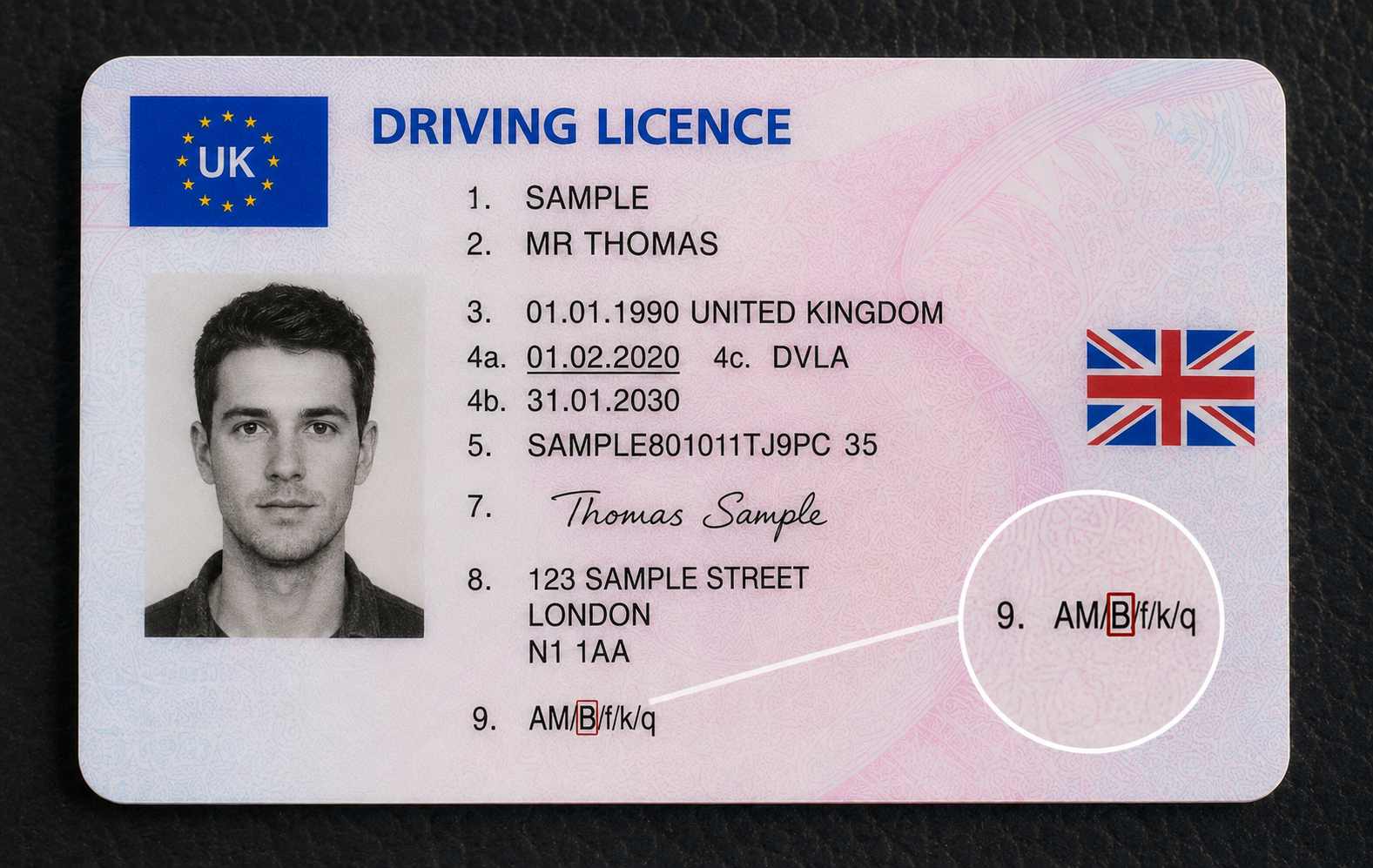
No. For driving a road-legal supercar on UK public roads, your standard Category B driving licence is legally sufficient. There's no supercar category, no extra endorsement and no additional test.
The DVLA's driving licence categories cover vehicles based on weight, passenger capacity, and propulsion type, not performance or power output. A Lamborghini Aventador, a Ferrari SF90, and a McLaren 720S all fall under Category B (standard car licence): vehicles up to 3,500kg, up to 8 passenger seats. Speed, horsepower, and the ability to reach 200mph in the hands of an experienced driver are not considerations in the licensing framework.
This means that, in theory, someone who passed their driving test last month could legally drive a Porsche 911 Turbo S on public roads the following week. Whether a hire company will let them is a different question entirely, but the licence law itself has no power-based restriction.
What about a "supercar licence"? Proposals for special licences on high-powered cars appear in the press from time to time, often compared with South Australia's U-Class (Ultra High Performance) licence. As of 2026, none has been adopted in the UK. If one is ever introduced, it will come through the DVLA with a transition period.
Driving Licence Requirements: The Detail That Matters Most
Your licence is not just proof that you can drive. It's the primary document through which hire companies assess your risk profile. Here's what they're looking for:
Licence Type
You need a full driving licence. Not provisional. Not learner. Full.
In the UK context, this means you have passed the practical test and hold a full GB driving licence (the pink photocard). For automatic-only licences, note that most supercars are automatic or semi-automatic in practice, but confirm with your provider that an automatic licence is acceptable for the specific car you want.
How Long You've Held It
This is where requirements diverge more between providers than most people realise:
- Standard minimum, 24 months: The most common threshold across the luxury hire market. Most providers require a full licence held for at least two years.
- Stricter requirement, 5 years: The strictest specialists require a full licence held for at least five years for hires under three months. This is at the stricter end but not unusual for top-tier supercar hire.
- Long-term hire exception: For hires over three months, some providers relax the licence duration requirement, accepting two years' experience rather than five.
If you passed your test relatively recently (say, three or four years ago), you'll qualify at most providers but not all. For five-year requirements, passing your test at 17 means you'd qualify from 22; at 21, from 26. Worth knowing before you assume a 25-minimum is the only threshold that applies to you.
Endorsements and Penalty Points
This is the area where people most frequently run into unexpected obstacles. The requirements are clear and essentially non-negotiable:
Automatically disqualifying (in the last 5 years):
- DR (drink-related driving offences)
- DG (drug-related driving offences)
- DD (dangerous driving)
- BA (driving while disqualified)
- CD40–CD70 (serious licence offences)
- Any conviction that resulted in a court-imposed disqualification
If you have any of the above in the last five years, you will not be able to hire a supercar through specialist UK hire firms. No exceptions.
Maximum penalty points:
- Most specialist providers: no more than 6 points in the last 3 years
- Some providers accept up to 6 points total; others require fewer
Common minor endorsements (SP30, SP50) and supercar hire: A single SP30 (speed limit offence) carrying 3 points: most providers will accept this, though it's always worth confirming. Two SP30s totalling 6 points: borderline and dependent on the provider. SP50 (motorway speeding): treated more seriously by some providers than an SP30, even at the same point value.
If you have any endorsements, minor or otherwise, the most efficient approach is to check the provider's licence terms before you book. Five minutes of checking confirms whether you qualify before you've invested time in a booking that won't be confirmed.
Manual vs Automatic Licence
A UK licence is either unrestricted (manual and automatic) or automatic only (restriction code 78). Most modern supercars use paddle-shift or dual-clutch gearboxes, which count as automatic, so an automatic-only licence covers them. Older Ferraris, some Porsche 911 variants and classic supercars are manual and need a full manual licence.
| Gearbox Type | Manual Licence | Automatic-Only Licence |
|---|---|---|
| Traditional manual gearbox | ✓ Can drive | ✗ Cannot drive |
| Paddle-shift / dual-clutch (e.g. Ferrari DCT) | ✓ Can drive | ✓ Can drive |
| Conventional automatic | ✓ Can drive | ✓ Can drive |
If you hold an automatic-only licence, check the gearbox on the specific car before you book.
Documents: What You Need to Bring (or Submit in Advance)
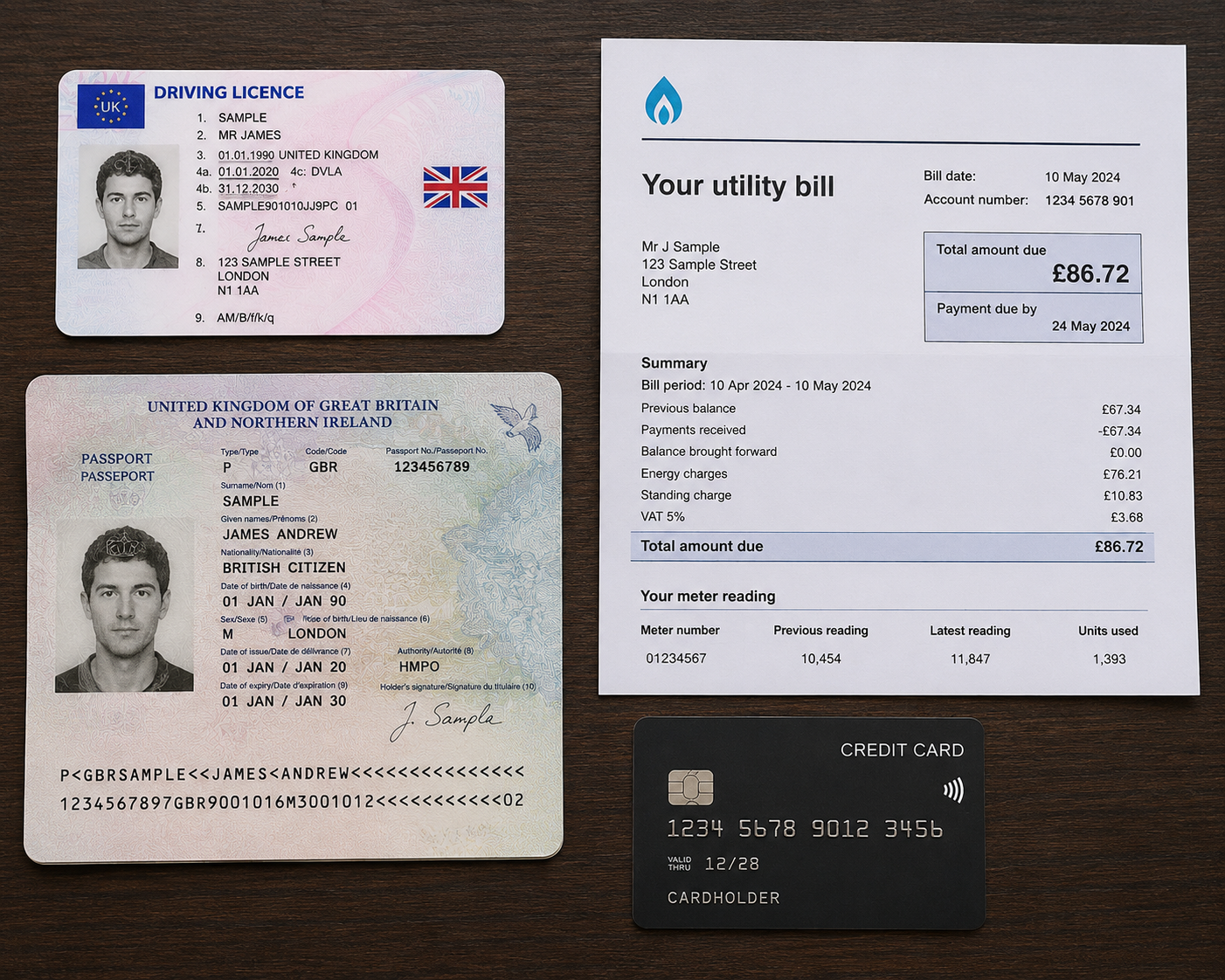
UK specialist supercar hire requires more documentation than standard rental. Have all of this ready before your booking reaches the verification stage:
Required by all providers:
- Full UK driving licence: the physical plastic card, not a digital version or screenshot. Both the photocard and, if applicable, the paper counterpart
- Passport (or government-issued photo ID): passport is the standard; some providers accept a national ID card for EU nationals
- Proof of address: a utility bill, bank statement, or HMRC correspondence dated within 60–90 days. Must show your current address, not a previous one
Required by most specialist providers: 4. Credit card in your own name: with adequate available credit for the security deposit (see below). Some providers explicitly decline debit cards for the security hold; others accept both 5. Second proof of identity: for very high-value cars, some providers request a second form of ID alongside the passport
Sometimes required: 6. National Insurance number: used for enhanced insurance checks by some providers, particularly for higher-value vehicles 7. International Driving Permit (IDP): required for visitors whose driving licence is not in Roman script, or in some cases for non-EU international licences
For additional drivers: Each additional driver on the policy must submit their own documentation and independently meet all age, licence, and endorsement requirements. Most providers charge a per-day additional driver fee.
How the Licence Check Works
Before handover, the partner checks your driving record with the DVLA. There are two ways to do it.
- A DVLA share code. Use the View Driving Licence service on GOV.UK to create a code that gives read-only access to your record for 21 days. It takes about two minutes. Create it before collection day and bring it with you.
- Your National Insurance number. Some partners run the check themselves with it.
The check shows any points, endorsements or disqualifications. If your record doesn't meet the partner's rules, the hire can be declined at the counter, so mention any points when you book.
What Counts as Proof of Address
| Document | Usually accepted? |
|---|---|
| Gas, electric or water bill | Yes |
| Bank or building society statement | Yes |
| Credit card statement | Yes |
| Council tax bill | Yes |
| Mortgage statement | Yes |
| Mobile phone bill | Often not |
| Online-only statement without a letterhead | Often not |
It must show your full name and current address, and most partners want it dated within the last 30 to 90 days. Accepted photo ID is a passport, a national ID card, or an armed forces or police warrant card. Student and work ID cards are not accepted.
What You Sign on Collection Day
- The rental agreement. Read the excess, the mileage allowance, the exclusions and the cancellation terms before you sign.
- The condition report. You and the partner walk round the car and record every mark. Take your own timestamped photos of every panel, all four wheels and the interior at the same time.
- The additional driver declaration. Any named extra driver must be there in person with their own licence, photo ID and proof of address.
Your Document Checklist
- Full photocard driving licence (the physical card, in date)
- DVLA share code or your National Insurance number
- Passport or other accepted photo ID (in date)
- Proof of address dated within 30 to 90 days
- A credit card in your name with room for the deposit
- Visitors: an International Driving Permit if your licence isn't in Latin script, plus proof of accommodation
The five mistakes that most often hold up a handover: a photo of the licence instead of the card, an expired licence or passport, proof of address that is too old, a debit card for the deposit, and an extra driver who isn't there.
Security Deposits: The Financial Requirement
The security deposit is not optional and it is not charged. It is held on your credit card during the hire period, released when the car is returned undamaged.
| Vehicle Tier | Typical Security Deposit Range |
|---|---|
| Sports cars (Audi R8, Porsche 911) | £2,000–£3,500 |
| Supercars (Ferrari 488, Lamborghini Huracán) | £4,000–£6,000 |
| High-value supercars (McLaren 720S, Ferrari F8) | £5,000–£8,000 |
| Ultra-premium (Rolls-Royce, Bentley) | £3,000–£7,500 |
| Hypercars | £20,000–£70,000+ |
Why a credit card is required (and debit often isn't accepted): A security deposit hold of £5,000 on a credit card is a reserved-but-not-charged amount. On a debit card, this works differently: many banks process a hold differently, or the funds may not be available. For high-value vehicles, most specialist hire firms require a credit card specifically. If this is a concern, check which cards are accepted before you book.
When the deposit is returned: On Autofusion the deposit is held as a pre-authorisation and released within 7 days of the hire ending, under the Autofusion Deposit Guarantee. This affects your available credit during that period, so factor it in if the hire falls just before other planned expenditure.
What Can Disqualify You: The Clear List
For complete transparency, here are the things that will typically prevent you from hiring a supercar in the UK, regardless of which provider you approach:
- Age below the minimum for the specific car and provider (typically 25 or 30)
- Licence held for insufficient time (typically less than 2 years for most; less than 5 years for stricter providers)
- Major endorsements in the last 5 years (DR, DG, DD, BA, or any court disqualification)
- More than 6 penalty points on the licence
- No valid passport or government ID: an expired passport is not accepted
- No credit card with adequate limit for the security deposit
- Proof of address older than 90 days: many people are caught by this with an old bank statement
- Insufficient credit card limit: the card must have the deposit amount available as headroom, not just a nominal limit
- No UK address for non-residents: some providers require a UK address; others accept international visitors with hotel address confirmation
Requirements for International Visitors
If you're visiting the UK and want to hire a supercar, additional considerations apply:
EU/EEA driving licences: Generally accepted directly for most supercar hire in the UK. No IDP typically required.
Non-EU/EEA licences: You'll usually need an International Driving Permit (IDP) alongside your national licence. The IDP must be obtained in your home country before you arrive. It's not available in the UK. A visitor can drive on a valid overseas licence for up to 12 months; UK residents with an overseas licence may then need to exchange it for a UK one.
Licences not in Roman script: An IDP is typically required for licences issued in Arabic, Chinese, Japanese, Korean, Cyrillic, or other non-Roman scripts.
Additional documentation: International visitors may also be asked to provide hotel confirmation as proof of UK address during the stay, and some providers require confirmation of return travel (flight booking or similar).
One important note: The verification process for international visitors can take longer than for UK residents. Allow additional time (ideally 48+ hours before your hire date) for documentation checks to complete.
What UK Law Says About Driving a Hired Supercar
There is no specific "supercar law" in the UK. What applies is ordinary UK motoring law, plus the contract the hire partner adds on top. Understanding which rules come from where helps you hire with confidence.
| Requirement | Legal Minimum | Typical Operator Requirement |
|---|---|---|
| Driving licence | Category B (standard) | Full licence, clean record |
| Minimum age | 17 (to hold a licence) | 25–30 depending on vehicle |
| Licence held for | No minimum in law | 2–5 years minimum |
| Penalty points | No formal limit for road use | Maximum 6 points |
| Serious offences | No automatic bar in law | DD, DR, TT codes typically disqualify |
| Vehicle categories | None (Category B covers all) | Vehicle-specific age requirements |
These aren't laws. But breaching them creates two practical problems: you won't be insured, and you'll be in breach of contract. The commercial and financial consequences of either can be severe.
Speeding and Camera Fines
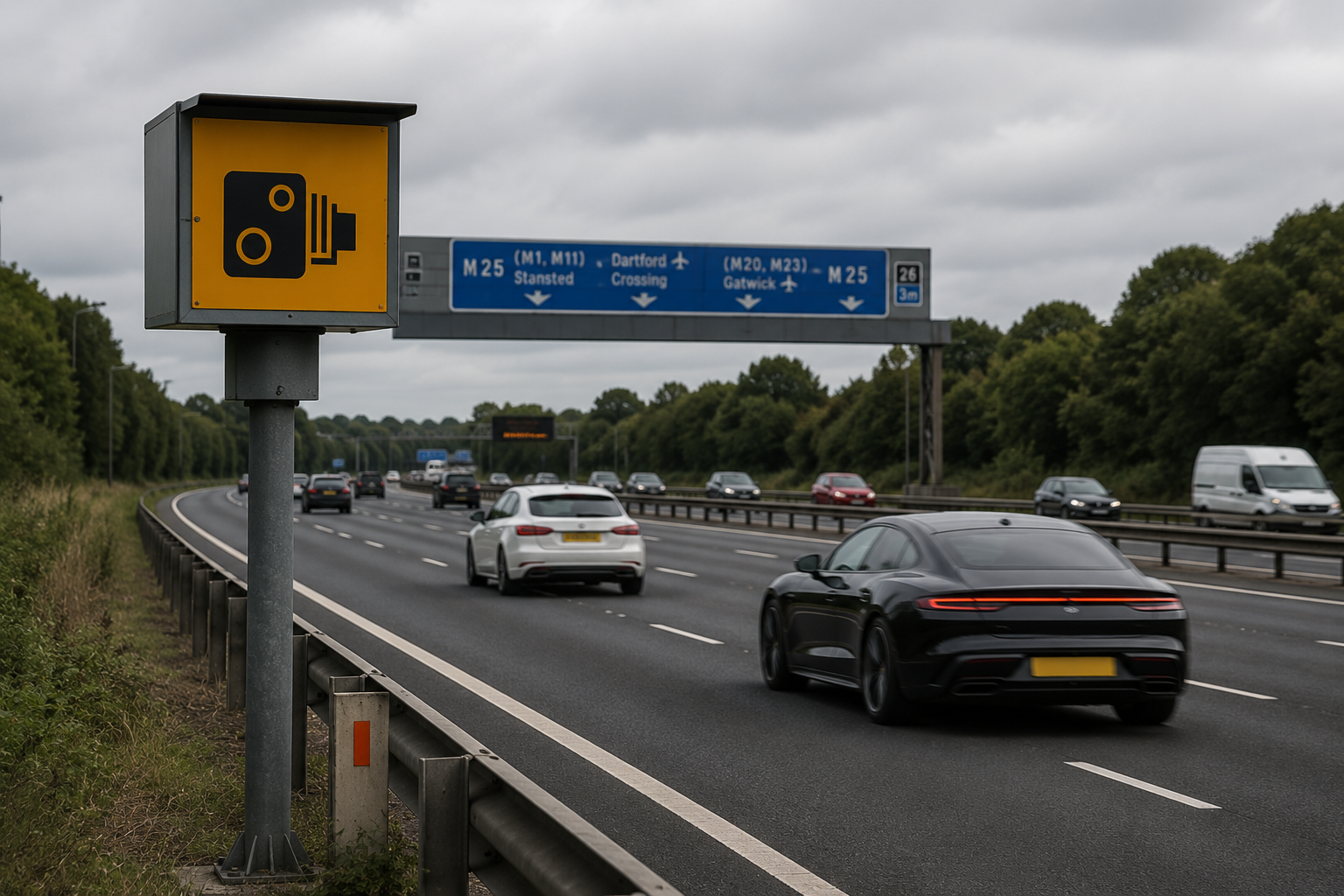
Speed limits apply uniformly to all vehicles. A Ferrari doing 120mph on a 70mph motorway is committing the same legal offence as any other vehicle, but with several additional complications:
- Speeding penalties (fines, points, disqualification) can be applied to the hirer if the vehicle is caught by a fixed camera during your hire
- The hire operator receives any penalty notices and passes them to you, usually with an administration fee added
- Multiple speeding incidents during a hire can result in prosecution
- Speed cameras are significantly more active in the UK than in most European countries: the enforcement infrastructure is real
The hire operator is typically named as the registered keeper of the vehicle. Camera fines are issued to them and redirected to you. There is no practical route to avoid this.
Careless and Dangerous Driving
Section 2A and Section 3 of the Road Traffic Act 1988 define careless driving (driving below the standard of a competent driver) and dangerous driving (driving far below that standard, creating obvious risk). Both apply identically to hire vehicles.
A court assessing whether driving was careless or dangerous considers what a competent driver of that vehicle would do. Driving a 600bhp Lamborghini requires a higher level of competence than driving a family hatchback: the vehicle's capability creates higher responsibility, not lower.
The penalties in brief:
- Careless driving: £100 and 3 points, or court prosecution with an unlimited fine and possible disqualification
- Dangerous driving: up to 2 years in prison, an unlimited fine and mandatory disqualification
- Drink or drug driving: minimum 12-month ban, unlimited fine, and the hire insurance is void, leaving you personally liable for all damage
The hire company is not liable for traffic offences committed during your hire. You are, in all cases, the responsible driver.
Noise and Anti-Social Use
This is the area where public debate is most active. High-powered cars generate significant noise, and the use of hired supercars for what's colloquially called "showing off" (deliberately revving engines in residential areas, performing illegal street racing, making repeated passes through town centres) has attracted significant legal and political attention.
Existing UK laws that apply:
- Road Traffic Act 1988, Section 3 (careless or inconsiderate driving) covers driving that inconveniences other road users, which can include deliberate and aggressive noise-making
- Section 59 of the Police Reform Act 2002 allows police to seize vehicles used in a manner causing alarm, distress, or annoyance, including hired supercars
- Public Spaces Protection Orders (PSPOs) can be used by local councils to restrict specific behaviours in defined areas. Several UK towns and cities have either implemented or discussed PSPOs aimed at antisocial supercar use
What this means for hirers: Driving a hired supercar responsibly (within speed limits, without aggressive noise-making in residential areas, without intimidating other road users) means existing law is not a concern. Using a hired car as a prop for antisocial street behaviour creates genuine legal risk.
Calls for tighter supercar hire rules, including more active use of PSPOs and noise orders, come up regularly. As of 2026 none has become law, but the debate is live.
Taking a Hired Supercar Abroad
Standard UK supercar hire contracts restrict the vehicle to the United Kingdom unless international use is specifically authorised in writing. Taking the car abroad without authorisation is a breach of contract that typically voids the insurance, with potentially significant legal and financial consequences if anything goes wrong.
If international travel is authorised:
| Requirement | Details |
|---|---|
| Written operator permission | Mandatory: verbal confirmation is insufficient |
| Green Card | Required for most European countries as proof of insurance |
| V5C registration document | Required in many European countries for roadside checks |
| Valid UK or international licence | Plus IDP if required in the destination country |
| Compliant vehicle insurance | Must cover the specific countries visited |
Post-Brexit, UK motor insurance provides third-party cover in EU countries as a minimum (under the Motor Vehicles [Compulsory Insurance] Regulations), but the higher levels of cover you're insured for under the hire policy may not automatically extend. Confirm the exact coverage territory with the operator before any international journey.
The practical advice: If you want to take a hired supercar to Europe (an Alpine driving trip, a weekend in Paris), raise this before you book. Some operators accommodate it with appropriate documentation; others prohibit it entirely.
Track Days and Private Land
The legal position: Private land, private circuits, and airfields are not subject to road traffic law. The standard UK road traffic framework (speed limits, licensing requirements, mandatory insurance) does not apply on private land.
The contractual position: Virtually all UK supercar hire contracts explicitly prohibit track use. The language typically covers: racing, timed events, track days, off-road driving, and use on any surface not intended for public road use.
This prohibition exists because hire operators' insurance policies, which cover road use, do not extend to track use. The moment a hired car goes on a circuit, the insurance is void. Operators cannot insure for track risk at standard hire rates.
The practical consequence: If you drive a hired supercar onto a circuit, lose control, and crash it, you are personally liable for the full repair or replacement cost, not just your excess. For a Lamborghini Aventador, that could exceed £300,000.
Some specialist operators do offer dedicated track hire with appropriate cover, but these are separate products, booked explicitly, not standard hire terms extended to a different environment.
If you want to use a supercar's performance legally, see where you can drive fast in the UK.
Track Day, Junior and Racing Licences
Track experiences sit outside standard hire and have their own rules:
| Activity | Licence Required |
|---|---|
| Supercar on public road | Standard Category B (road) |
| Supercar hire (self-drive) | Full UK licence + operator's specific criteria |
| Track day experience (non-competitive) | Full driving licence (criteria vary by operator) |
| Junior track experience | No licence required (age minimum applies) |
| Competitive circuit racing | Motorsport UK competition licence (ARDS test required) |
Most track day providers accept a full valid licence from any country, often with a minimum of 2 to 3 years held for higher-powered cars, and require you to communicate with instructors in English. Some run supervised sessions for 17-year-olds on provisional licences, and junior experiences in dual-control cars from age 10 or 12. Competitive racing needs a Motorsport UK licence, gained through an ARDS test at a registered racing school.
Your Consumer Rights as a Hirer
Unfair contract terms: Under the Consumer Rights Act 2015, contract terms must be transparent and fair. A hire company cannot include a clause that is fundamentally unfair or that significantly undermines your rights as a consumer, even if you signed it.
Right to clear information: Operators are required to make material terms (excess amounts, restrictions, cancellation terms) clear before you commit. Hidden charges or terms that weren't clearly communicated at the time of booking can be challenged.
Protection against fraud: Never pay the full balance or security deposit by bank transfer. Reputable operators process deposits by credit card, held as a pre-authorisation. If a "company" insists on bank transfer or won't operate from verified premises, that's a significant warning sign.
Practical advice for staying protected:
- Keep all written correspondence and booking confirmations
- Never sign a contract with blank sections: ask for completion before signing
- Pay by credit card where possible: Section 75 of the Consumer Credit Act provides additional protection on purchases over £100
- Book through a verified platform or operator, so there is clear accountability
Requirements Within the Contract
Meeting the initial eligibility requirements is one thing. The hire contract itself imposes ongoing requirements during the hire:
Mileage limits: Most supercar hire contracts include a daily mileage allowance, typically 75–150 miles per day. Excess mileage is charged per mile beyond the allowance, usually £1–£3/mile. Know your allowance and track your mileage.
No track use: Almost universally, supercar hire contracts prohibit use on racing circuits, track days, or driving experience events. Specialist track insurance is required for this, which is not included in standard hire coverage.
No unauthorised drivers: Only the drivers named on the hire agreement may drive the vehicle. Allowing an unlisted person to drive is a breach of contract and invalidates the insurance.
Fuel policy: Most specialist hire operates on a full-to-full basis. Return the car with less fuel than it had at collection and you'll pay a premium refuelling fee.
Timely return: Late returns incur additional charges, typically at the full daily rate pro-rated by the hour. Communicate any unavoidable delays as early as possible.
If You Don't Qualify Yet: The Honest Path Forward
If you're under 25, have recent endorsements, or haven't held your licence long enough, this isn't a permanent situation, and it's worth planning around rather than giving up on.
Under 25: Access to performance sports cars (Porsche 718, Jaguar F-Type, Audi TT RS) is usually available from 21–23 and provides a genuine performance experience while you build towards the supercar tier.
Recent points: Most minor endorsements have a 3–4 year relevance window for hire purposes. A single SP30 from three years ago will age off soon. Drive cleanly, let it expire, and the path clears.
Insufficient licence time: If you've recently passed your test, the two-to-five-year requirement is simply a waiting period. It is genuinely waiting, not a permanent barrier.
Major endorsements: These are the hardest to work around, as they typically require five years to age out from the date of conviction. Some specialist providers will discuss individual circumstances, but the standard position is a five-year exclusion window.
At a Glance: What You Need
| Requirement | What applies |
|---|---|
| Licence type | Full Category B licence; no special supercar licence exists |
| Licence held | Usually 2 years; up to 5 for top-tier cars |
| Age | Usually 25+; 28 to 30 for flagship models |
| Points and endorsements | Maximum 6 points; DR, DD, DG, BA, CD and TT codes typically disqualify |
| Documents | Photocard licence, passport, proof of address, DVLA share code or NI number |
| Deposit | Credit card in your name with enough headroom |
| Track use and travel abroad | Prohibited unless the partner authorises it in writing |
| Consumer protection | Consumer Rights Act 2015 applies |
The requirements exist to protect everyone involved: the hire company, the insurance, the other people on the road, and you. They're not arbitrary hoops. Understanding exactly where you stand takes fifteen minutes and turns a vague aspiration into a clearly planned one.
Keep reading: Supercar Hire Insurance Explained, What Happens If You Crash a Hired Supercar? and Best Supercars for a First Hire.
Ready to compare supercar hire options across the UK? With Autofusion you can search, compare and book on the spot, so you find the right provider with the right requirements for your specific situation.