



Published 30 July 2026
Our methodology focuses on accuracy first.
All information is researched using manufacturer data, official industry guidance, and trusted automotive sources. Where relevant, content is cross-checked against real-world vehicle maintenance practices and common customer enquiries to ensure it is both practical and accurate. Our content is reviewed regularly and updated to reflect changes in regulations, industry standards, and best practices.

Let's address the question that lives in the back of every first-time supercar hirer's mind from the moment they sign the rental agreement: what actually happens if I crash it?
It's not a comfortable thing to think about. But it's exactly the right thing to think about — before you take the car, not after. Because the answer is both more manageable and more nuanced than most people assume, and knowing it clearly allows you to drive with appropriate care rather than either reckless confidence or paralysing anxiety.
Here's the honest, complete answer.
The Short Version
You are not personally liable for the full replacement value of a hired supercar if you crash it. That's the first thing to understand, and for most people reading this, it's probably already a relief.
Comprehensive motor insurance is included as standard with all legitimate UK supercar hire packages. In a straightforward at-fault accident on a public road, your financial liability is capped at the insurance excess — the amount stated in your hire contract, typically ranging from £3,000 to £15,000 depending on the vehicle. The insurance covers the rest.
The exception — the scenario where that liability cap disappears — involves specific circumstances that void the insurance. We'll come to those. But the baseline answer for a standard road accident is: you pay your excess, the insurance covers everything above it.
What Happens Immediately After a Crash in a Hired Supercar
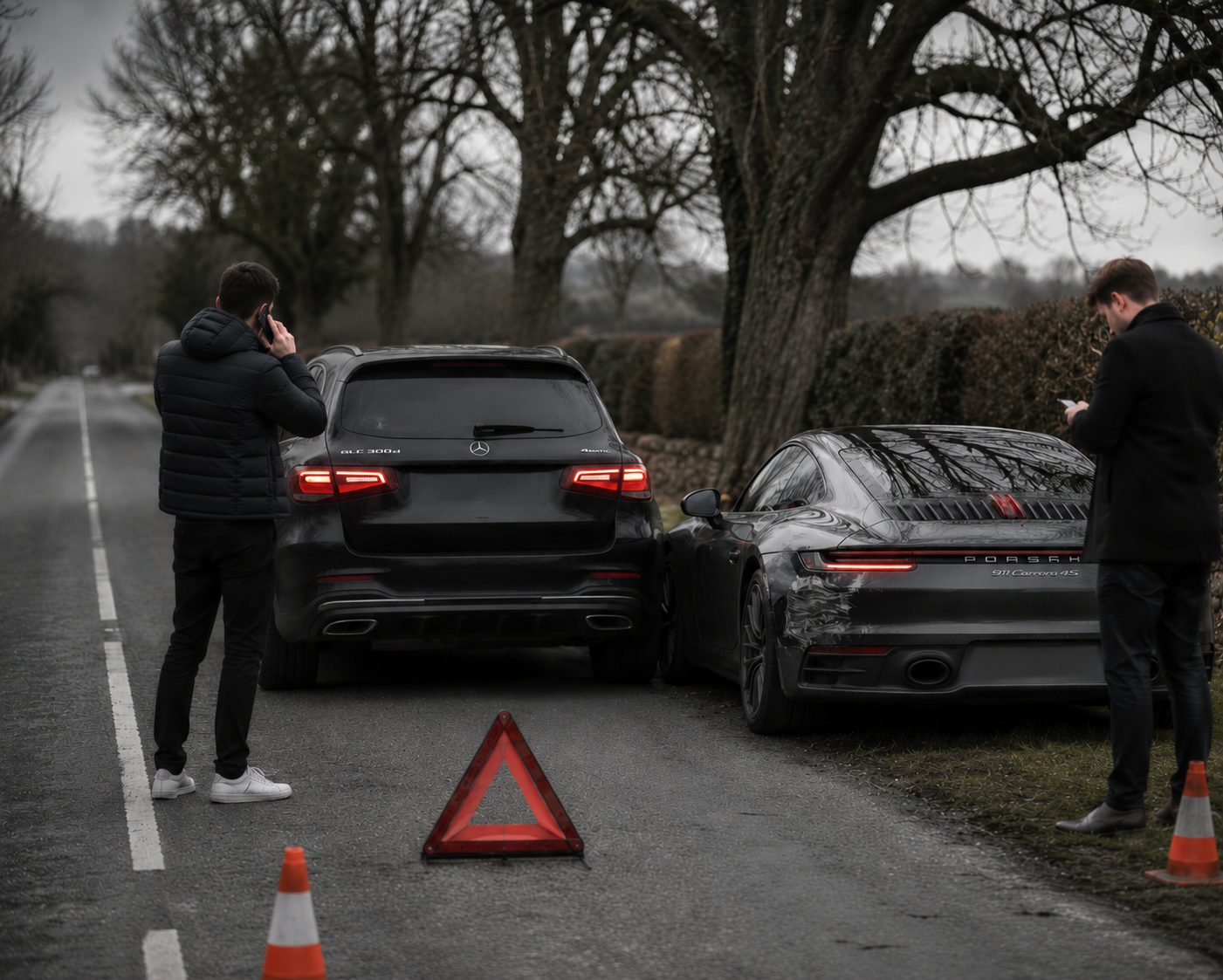
The sequence of events after any accident in a hire car — regardless of whether it's a supercar or not — follows a predictable process. Knowing it in advance makes it manageable.
At the Scene
Step 1: Ensure safety first. Get yourself and any passengers clear of danger. If the accident involves other vehicles, check on other parties. Call 999 if anyone is injured or if the road is blocked.
Step 2: Call the police if required. In the UK, you must report an accident to the police within 24 hours if:
- Injury has occurred to any person
- You were unable to exchange details with the other party at the scene
For minor, damage-only accidents between consenting parties who exchange details, you're not legally required to call the police immediately — though you may choose to.
Step 3: Photograph everything. Before any vehicle is moved, photograph:
- The full scene from multiple angles
- All vehicles involved, including number plates
- Any visible damage — close up and from distance
- The road surface, any skid marks, road markings
- Weather conditions and visibility
These photographs are your evidence. They establish the condition of all vehicles at the point of the incident and can resolve disputes about when or how damage occurred.
Step 4: Exchange details. With any other party involved: name, address, phone number, vehicle registration, and insurance details.
Step 5: Contact the hire company. Most operators require you to notify them immediately or within a specified window (often 24 hours) of any incident. This is a contract requirement — failing to notify promptly can complicate the insurance claim process.
Your Financial Liability: What You Actually Pay
Assuming a standard at-fault road accident with the insurance remaining valid, your liability is limited to the insurance excess:
| Vehicle Type | Typical Insurance Excess |
|---|---|
| Prestige GT (Porsche 911, Audi R8) | £3,000–£6,000 |
| Supercar (Ferrari 488, Lamborghini Huracán) | £5,000–£10,000 |
| Flagship exotic (McLaren 720S, Lamborghini Aventador) | £8,000–£15,000 |
| Ultra-luxury (Rolls-Royce Phantom, Bentley Flying Spur) | £4,000–£8,000 |
The insurance covers all costs above your excess, including:
- Repair or replacement of the hire vehicle
- Third-party property damage
- Third-party bodily injury liability
Your security deposit is typically held as the collateral for this excess. If your deposit was £8,000 and the repair costs £6,000, the operator retains £6,000 from the deposit and returns £2,000. If the repair costs £15,000 and your excess is £8,000, you pay £8,000 and the insurance covers the remaining £7,000.
What Happens to Your Security Deposit After a Crash?
The deposit is the practical mechanism through which your excess is collected. Here's how it typically works:
If the damage is under your excess amount: The operator uses your deposit to cover the repair cost. The remainder is refunded.
If the damage equals or exceeds your excess: Your full deposit is retained to cover your excess liability. The insurance pays the remaining repair cost.
If you have an excess waiver: Your deposit is released in full; the waiver product covers your liability instead.
Important note: Even with excess insurance (a standalone third-party policy), the sequence is: operator charges your deposit → you claim reimbursement from the excess insurer. The deposit is charged first; the reimbursement comes after. You need the credit available on your card at the time of the accident.
Does Third-Party Damage Get Covered?
Yes. The comprehensive insurance included in UK supercar hire covers third-party liability — meaning if you damage another person's vehicle, property, or if you injure someone in the accident, their costs are covered by the hire insurance (not personally by you, beyond your excess).
Third-party liability cover is typically unlimited in the UK under the Road Traffic Act. This means that if the accident causes significant injury to another party, the insurance covers their claim regardless of the amount — you are not personally liable for third-party injury costs beyond what the insurance provides.
This is a critically important point. The excess is a cap on your liability for damage to the hire vehicle itself. Third-party costs — another car, someone's fence, injuries to other parties — are covered by the third-party liability element of the insurance, which operates separately.
When Does Insurance Become Void?
This is the section that matters most. In certain circumstances, the insurance covering your hire can be voided entirely — leaving you personally liable for the full cost of the vehicle and any damage.
The scenarios that can void your hire insurance:
| Scenario | Insurance Status |
|---|---|
| Normal at-fault road accident | ✓ Insurance valid — you pay excess only |
| At-fault accident on a public road in permitted territory | ✓ Insurance valid — you pay excess only |
| Track use (circuits, private roads for racing purposes) | ✗ Insurance void — full liability |
| Off-road use (except on defined roads) | ✗ Insurance void — full liability |
| Driving under the influence of alcohol or drugs | ✗ Insurance void — full liability |
| Reckless or dangerous driving (as defined legally) | ✗ Insurance void — full liability |
| An unauthorised driver (not named on the hire agreement) | ✗ Insurance void — full liability |
| Driving in countries or regions not covered by the contract | ✗ Insurance void — full liability |
| Breach of specific T&C conditions by the hirer | Potentially void — depends on the breach and contract terms |
The most common scenarios that create problems are track use and unauthorised drivers. Driving a hired Lamborghini onto a circuit — even for a "quick lap" — is not covered by the standard hire insurance. Letting a friend drive when they're not named on the agreement is not covered. These aren't edge cases; they happen, and the financial consequences are severe.
Loss of Use and Administration Charges
Here's a cost that surprises many people who have experienced an accident: the repair cost isn't always the only charge.
Loss of use fees: While the vehicle is being repaired and can't be hired out, the operator may charge you for the lost income. This is typically framed in the contract as a "loss of use" or "loss of earnings" clause. For a supercar hire at £1,000/day, a two-week repair period represents significant lost revenue.
Whether this applies depends on:
- Whether your hire contract includes a loss of use clause (read it)
- Whether the damage is covered by the included insurance (some policies include loss of use; others don't)
- Whether you have an excess waiver or protection product that covers this
Administration fees: Many hire contracts also include an administration charge for processing a damage claim — typically £50–£300. This covers the operator's internal cost of managing the incident, liaising with their insurer, and organising repairs.
These charges sit alongside the excess rather than within it — they can be in addition to whatever repair cost your excess covers. Ask your operator explicitly whether loss of use and admin fees are included within your excess cap or additional to it.
What If Someone Else (a Named Second Driver) Crashes the Car?
Named additional drivers are typically covered to the same standard as the primary hirer — subject to the same excess, the same insurance terms, and the same conditions of use.
The key word is named. An additional driver must be formally added to the hire agreement, their licence must be checked, and they must meet the same eligibility criteria. If they don't appear on the hire agreement, they are an unauthorised driver and the insurance is void regardless of the circumstances.
For the primary hirer: even if you weren't in the car when it was crashed by a named second driver, the financial liability for the excess typically falls on the primary hire agreement holder. The contract is in your name — the responsibility follows.
If You're Not at Fault, Can the Hire Company Still Hold Your Deposit?
Yes — temporarily. And this is genuinely frustrating, but it's the standard industry practice.
If another party is responsible for the accident, the hire company's insurer will pursue a recovery claim against that party's insurer. During this process — which can take weeks or months — the operator may retain all or part of your deposit as security while the claim is being processed.
Once liability is established and the other party's insurance pays out, your deposit should be released. But the timeline is the other insurer's timeline, not yours.
What to do if you're not at fault:
- Collect full details of the at-fault party at the scene — licence plate, name, insurance company, policy number
- Photograph everything that establishes the other party's fault (their position, the road layout, any witness statements)
- Report to police if appropriate
- Notify your hire company immediately with all the information
- Ask explicitly about the deposit retention process and expected timeline
The stronger your documentation of the not-at-fault scenario, the faster the recovery process typically moves.
Age, Licence Conditions, and How They Affect Cover After a Crash
If the driver at the time of the crash doesn't meet the hire company's stated requirements — wrong age, undisclosed endorsements, invalid licence — the insurance may be voided or partially voided.
Scenarios that can affect cover:
- Driver under the minimum age for the vehicle category — insurance typically void
- Driver has undisclosed endorsements beyond the operator's permitted limit — may void cover
- Driver holds an automatic-only licence but was driving a manual vehicle — cover may be affected
- Driver is under the influence — insurance void regardless of other conditions
These aren't hypothetical. They're the scenarios that operators confirm to insurers during claims processing. The DVLA check at collection is specifically to verify these criteria. Providing inaccurate information about your licence history at booking is both a contract breach and potentially insurance fraud.
Crashes Abroad or Outside Permitted Use Area
Standard UK supercar hire contracts restrict the vehicle to specified territories — usually mainland UK. Taking a hired supercar abroad without written authorisation from the operator is a breach of contract that typically voids the insurance.
If you crash the vehicle while driving in France on a hire that was only permitted for UK use, you are personally liable for all costs — including third-party damage, which in a serious accident could be considerable.
The rule: If you want to take a hire car outside its permitted territory, get written confirmation from the operator before you go. Not after. Before.
What to Do: The Crash Checklist
If the worst happens, here's the practical sequence:
At the scene:
- ✅ Ensure everyone is safe — call 999 if anyone is injured
- ✅ Do not admit fault to any party at the scene
- ✅ Photograph everything, immediately, before vehicles are moved
- ✅ Exchange full details with all parties involved
- ✅ Note any witnesses' details
Within 24 hours: 6. ✅ Contact the hire company and report the incident (most contracts require prompt notification) 7. ✅ File a police report if required (injury accident or hit-and-run) 8. ✅ If you have standalone excess insurance, contact your excess insurer and begin the claims process 9. ✅ Preserve all documentation — photos, third-party details, police reference number
Do not:
- ✗ Drive a damaged vehicle if it's unsafe to do so
- ✗ Fail to report the incident to the hire company
- ✗ Accept blame in writing or verbally without legal advice if the situation is disputed
- ✗ Attempt repairs without operator authorisation
Final Thoughts: The Calm Approach to an Unlikely Scenario
The statistical reality of supercar hire in the UK is that the vast majority of hires conclude without incident. These cars are driven by responsible adults who have paid significant deposits and who are acutely aware of what they're driving. Accidents are rare.
But rare is not zero, and the responsible approach to hiring an extraordinary vehicle is to understand the downside clearly before you leave the showroom. Now you do. The excess is your liability limit in a standard accident. The insurance covers everything above it. Specific behaviours — track use, drink driving, unauthorised drivers — can remove that protection entirely. And the deposit is the mechanism through which it all gets resolved.
Understand the terms, drive appropriately, buy the excess protection if it gives you peace of mind, and enjoy the experience. The car is worth it.
Ready to hire a supercar with full transparency about terms, insurance, and costs? Compare vehicles and operators from hundreds of hire partners across the UK with Autofusion — and book with your eyes fully open.