


Published 18 July 2026
Our methodology focuses on accuracy first.
All information is researched using manufacturer data, official industry guidance, and trusted automotive sources. Where relevant, content is cross-checked against real-world vehicle maintenance practices and common customer enquiries to ensure it is both practical and accurate. Our content is reviewed regularly and updated to reflect changes in regulations, industry standards, and best practices.
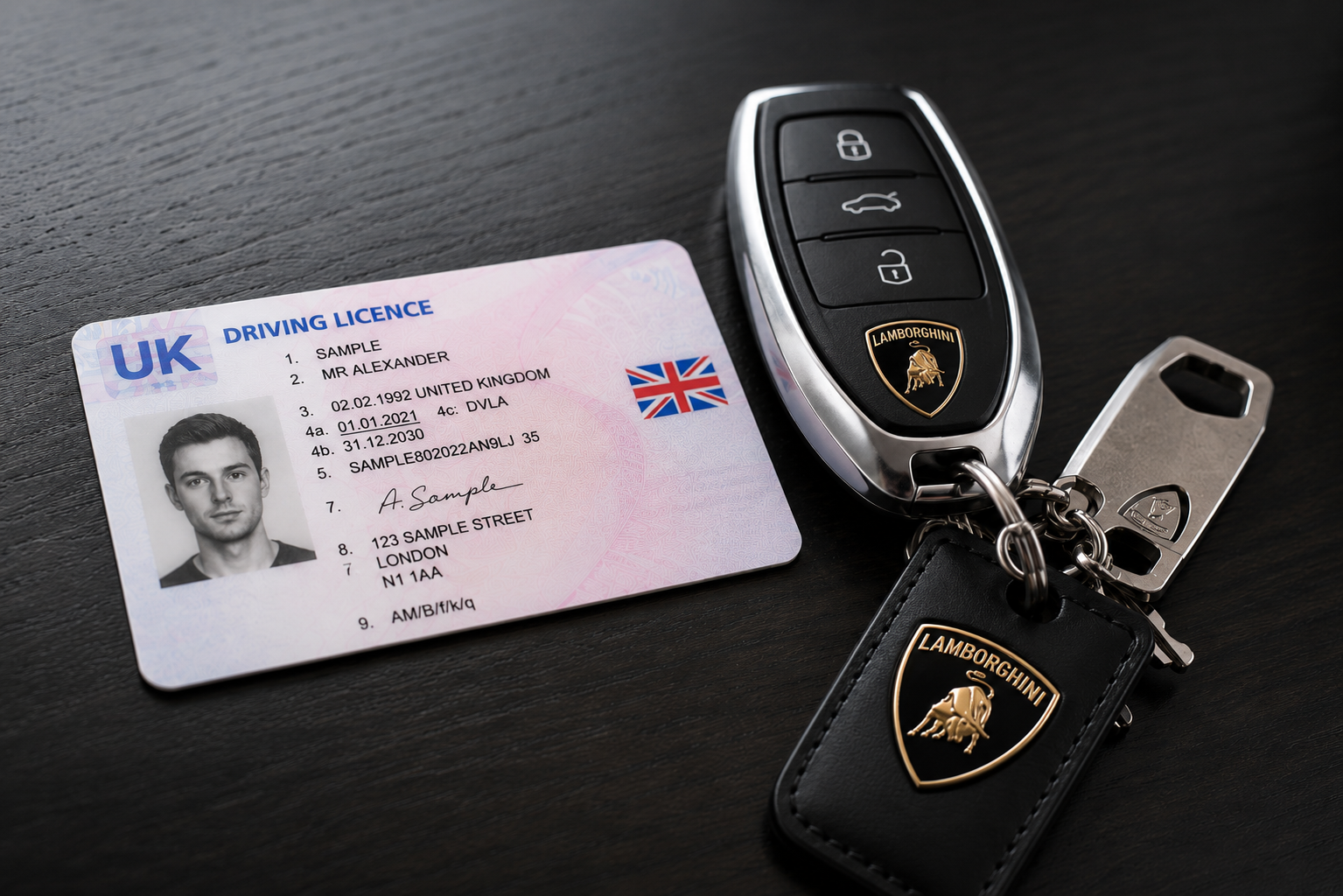
Here's something that surprises most people when they first look into driving a supercar: you don't need a special licence. No supercar category. No additional endorsement. No test that proves you can handle 600 horsepower without destroying a hedgerow.
For driving a road-legal supercar on UK public roads, your standard Category B driving licence — the one you already have — is legally sufficient. The car is the same category as a Ford Focus in the eyes of the DVLA, provided it meets the standard passenger car definitions.
That said, there's meaningful nuance here. Hire companies have their own requirements on top of the legal minimum. Track days have different rules. Racing has entirely different rules. Junior experiences have different rules again. This guide maps the full picture — so you know exactly where you stand before you try to book.
Do You Need a Special Supercar Licence in the UK?
No — not under current UK law. This is the foundational answer, and it's worth stating clearly.
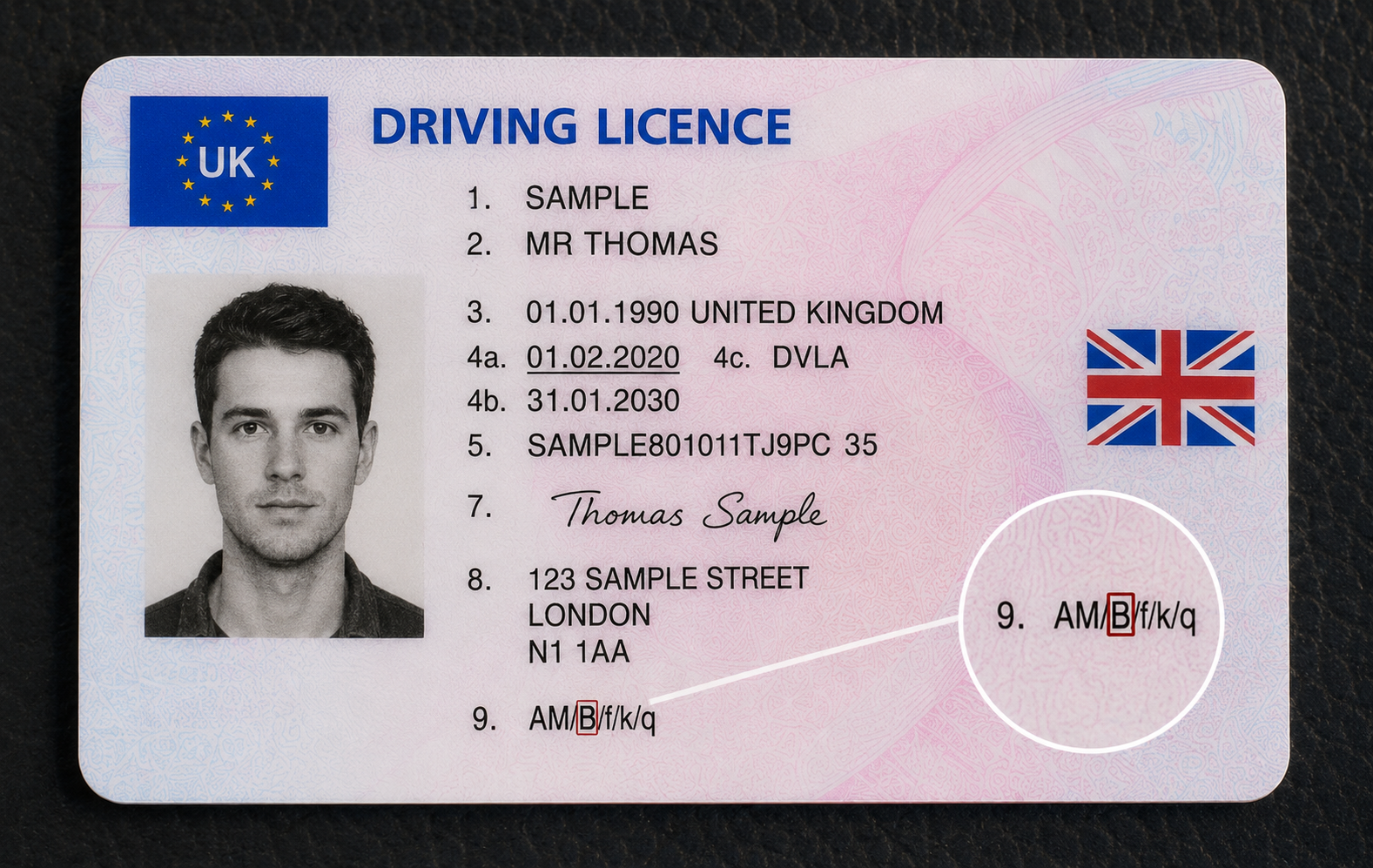
The DVLA's driving licence categories cover vehicles based on weight, passenger capacity, and propulsion type — not performance or power output. A Lamborghini Aventador, a Ferrari SF90, and a McLaren 720S all fall under Category B (standard car licence): vehicles up to 3,500kg, up to 8 passenger seats. Speed, horsepower, and the ability to reach 200mph in the hands of an experienced driver are not considerations in the licensing framework.
This means that, in theory, someone who passed their driving test last month could legally drive a Porsche 911 Turbo S on public roads the following week. Whether a hire company will let them is a different question entirely — but the licence law itself has no power-based restriction.
The Proposals for a "Supercar Licence" in the UK
Worth addressing directly, because these proposals appear in the press with some regularity and create genuine confusion.
There have been discussions in the UK about introducing special licence requirements for high-powered vehicles — often framed as a requirement for cars above 300bhp or 400bhp. The idea draws comparison with South Australia, which introduced a U-Class (Ultra High Performance) licence requiring drivers of vehicles above 370bhp per tonne to complete an additional qualification.
The current position in the UK: No such licence exists. As of 2026, these remain proposals, discussions, and media speculation — not DVLA policy. The standard Category B licence is the legal requirement for all conventional road-legal supercars in the UK.
If a formal supercar licence category is introduced in future, it will be announced through the DVLA and will almost certainly include a transition period. You don't need to take any additional test today.
What Hire Companies Actually Require (Beyond the Legal Minimum)
Here's where the practical requirements diverge from the legal baseline. Hire companies are under no obligation to hand their vehicles to anyone with a legal minimum entitlement — and for supercars specifically, they apply their own criteria based on insurance underwriting.
The standard requirements across the UK supercar hire market:
| Requirement | Typical Standard |
|---|---|
| Licence type | Full UK driving licence (not provisional) |
| Licence held for | 2 years minimum (some operators: 3–5 years) |
| Minimum age | 25 (some operators: 23 for lower-powered vehicles; 28–30 for flagships) |
| Points limit | Maximum 6 points in most cases |
| Endorsement exclusions | DD, DR, CD, TT codes typically disqualify |
| DVLA check | Required at collection (share code or NI number) |
| Manual vs automatic | Must match vehicle type (see below) |
The "minimum held for" requirement varies by vehicle — a mid-range supercar like a Ferrari 488 might require 2 years, while a flagship exotic like a Lamborghini Aventador may require 3–5 years of full licence history.
Manual vs Automatic Licence: Does It Matter?
Yes — and this is one of the most practically important nuances for supercar hire.
A UK full driving licence is categorised as either:
- Manual (Category B with no restrictions) — allows you to drive both manual and automatic transmission vehicles
- Automatic only (restriction code 78 on your licence) — limits you to automatic transmission vehicles only
For supercar hire, this matters because:
Most modern supercars use paddle-shift or dual-clutch automatic transmissions — a Ferrari with a DCT, a Lamborghini with an e-gear, a McLaren with SSG. These are technically automatic gearboxes, and an automatic-only licence holder can legally drive them.
Some supercars and performance cars are manual — older Ferraris, certain Porsche 911 variants, some classic supercars. These require a full manual licence.
For track experiences specifically: Most operators require a full manual licence for manual-transmission cars, but allow automatic licence holders to drive automatic supercars. Cars with particularly demanding characteristics (Ariel Atom, certain rally cars) may require manual licence regardless.
| Gearbox Type | Manual Licence | Automatic-Only Licence |
|---|---|---|
| Traditional manual gearbox | ✓ Can drive | ✗ Cannot drive |
| Paddle-shift / dual-clutch (e.g. Ferrari DCT) | ✓ Can drive | ✓ Can drive |
| Conventional automatic | ✓ Can drive | ✓ Can drive |
Practical note: If you hold an automatic-only licence and want to hire a supercar, the first question to ask any operator is whether their specific vehicle is a manual or automatic transmission. Many supercars in hire fleets are paddle-shift, which an automatic licence covers.
EU and International Driving Licences for Supercar Hire
The UK market has a clear and well-established framework for international licence holders:
EU licence holders: EU driving licences are recognised in the UK. A full EU Category B licence allows driving on UK roads for up to 12 months as a visitor; longer-term UK residents need to exchange their EU licence for a UK one.
For supercar hire specifically:
- Most operators accept full EU licences for road hire
- The DVLA check may require different verification methods for non-UK licences — some operators ask for proof of UK address alongside the licence
- EU licence holders should confirm operator-specific requirements at the enquiry stage
Non-EU international licences:
| Scenario | Requirement |
|---|---|
| Licence in English or Latin script | Usually accepted directly; some operators require proof of address |
| Non-Latin script licence (Arabic, Japanese, Chinese, etc.) | IDP (International Driving Permit) required alongside national licence |
| Visiting the UK short-term | National licence + IDP where required |
| UK resident with overseas licence | May need to exchange for UK licence after 12 months |
For track experiences specifically: Most UK experience providers accept full valid licences from all countries worldwide, with the common additional requirement of being able to communicate effectively with instructors in English. Communication on track is a safety requirement — you must be able to respond to marshals and instructors in real time.
Track Day Licence Requirements
Track day driving is a different context from road driving, and the licence requirements reflect that.
Standard track day experiences (non-competitive, instructor-led):
- Most operators require a full, valid driving licence from any country
- Manual licence often required for manual-transmission vehicles
- Some operators specify minimum years held (commonly 2–3 years for higher-powered track experiences)
- A provider running a Porsche 911-based experience may require the same licence as standard road hire; a provider running an Ariel Atom experience may require an additional risk assessment
The minimum years held requirement on track: Some operators specify that your licence must have been held for a minimum period — Silverstone's own supercar experience, for example, specifies that the full licence must have been held for at least three years. This varies by operator and vehicle.
Provisional Licence and Under-17 Supercar Experiences
This is a category that most people don't realise exists — and it's genuinely remarkable.
Provisional licence experiences (17-year-olds):
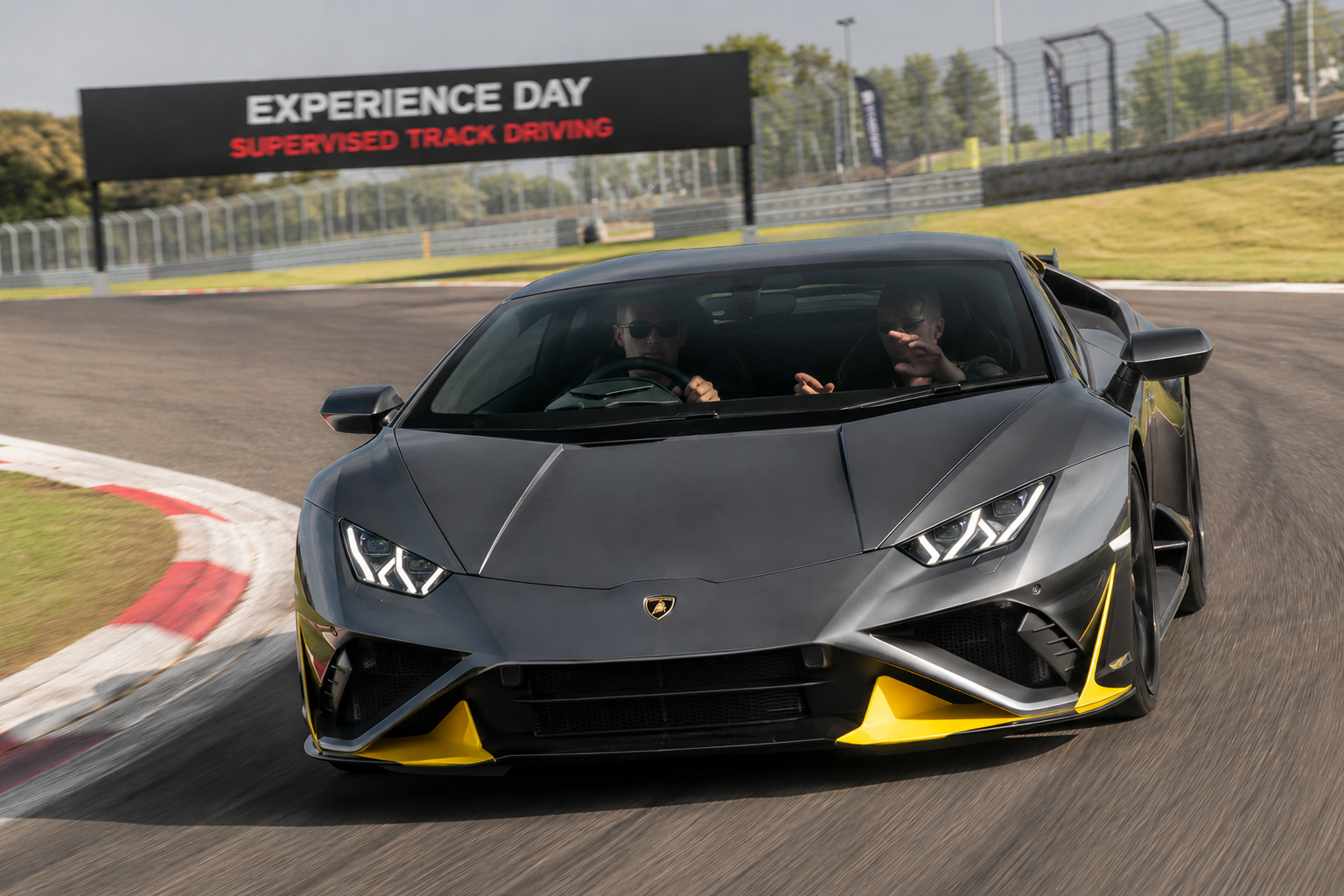
Some UK experience operators run dedicated sessions for 17-year-olds holding provisional licences, allowing them to drive supercars on private tracks under instructor supervision. These are not road drives — they're conducted on closed circuits or private land — but the cars are real supercars, the speeds are real, and the experience is genuine.
Junior supercar experiences (no licence required, from age 10–12):
Several major experience operators offer junior supercar driving days for children from age 10 or 12 upward. These use dual-control vehicles on private tracks, with experienced instructors who can intervene at any moment. No driving licence is required.
What these experiences include:
- Dual-control supercars (instructor has access to throttle and brake)
- Supervised, private track environment
- Age-appropriate coaching
- A genuine supercar model — not a modified road car
For parents looking to give a car-obsessed teenager or child an extraordinary gift, these experiences are worth knowing about. The age limits and specific formats vary by operator — always confirm directly.
Racing and Competition: The Motorsport Licence
Racing a supercar on a UK circuit — as in, competitive timed events — is a completely separate licence world from road driving or track day experiences.
To race in any organised event at a UK circuit, you need a Motorsport UK competition licence. This is obtained through:
- Purchasing a Motorsport UK "Go Racing Pack"
- Completing an ARDS test (Association of Racing Driver Schools) at a registered racing school — this is a formal assessment of your driving ability in a race environment
- Passing a medical eye test (eyesight check minimum; full medical required for some licence grades)
- Applying for the relevant licence grade through Motorsport UK
Important distinction: A track day experience (non-competitive, run by a private company on a circuit) does not require a Motorsport UK competition licence. Only competitive, timed, officially sanctioned motorsport events do.
| Activity | Licence Required |
|---|---|
| Supercar on public road | Standard Category B (road) |
| Supercar hire (self-drive) | Full UK licence + operator's specific criteria |
| Track day experience (non-competitive) | Full driving licence (criteria vary by operator) |
| Junior track experience | No licence required (age minimum applies) |
| Competitive circuit racing | Motorsport UK competition licence (ARDS test required) |
DVLA Checks: What Hire Companies Actually Look For
When you present your licence for a supercar hire, the operator conducts a DVLA check to verify your driving record. This is done either by:
- Checking your DVLA share code (generated at GOV.UK — a temporary code that gives the operator read-only access to your licence history)
- Using your National Insurance number to run the check directly
What the operator is looking for:
- Confirmation that your licence is valid and current
- Your licence category (manual or automatic restriction)
- Penalty points: most operators accept up to 6 points; some are stricter
- Endorsement codes: certain codes are automatic disqualifications
Endorsement codes that typically disqualify:
| Code | Offence |
|---|---|
| DR10, DR20, DR30 | Drink driving or drug-related driving offences |
| DD40, DD60, DD80 | Dangerous driving |
| TT99 | Totting up disqualification |
| CD10, CD20, CD30 | Careless or inconsiderate driving |
These aren't arbitrary — they reflect the specific risk profile that insurers won't cover for high-value vehicles. Minor speeding endorsements (SP10–SP50) are typically tolerated up to the 6-point limit.
Summary: What You Actually Need to Hire a Supercar in the UK
Here's the complete picture distilled:
For road-based self-drive hire:
- Full UK Category B driving licence (or equivalent international licence with IDP if required)
- Held for the period specified by the operator (typically 2–5 years)
- Aged 25 or over (varies by vehicle and operator)
- Maximum 6 penalty points; no serious endorsements
- Manual or automatic licence matching the vehicle's transmission
For track day experiences:
- Full valid driving licence (most operators)
- Manual licence for manual vehicles; automatic sometimes accepted for automatic-only track cars
- Minimum years held varies by operator and vehicle
- Age 17+ for most full experiences; 10+ for junior experiences
For competitive racing:
- Motorsport UK competition licence (requires ARDS test, medical)
- Separate from and in addition to your standard road licence
Final Thoughts: The Licence Is the Easy Part
The honest truth about supercar hire licence requirements is that for most UK drivers with a clean full licence held for a reasonable period, there's nothing standing between you and a Lamborghini except the booking. The legal framework is straightforward, the hire operators' requirements are reasonable, and the DVLA check takes minutes.
The main thing to do before you book is confirm the specific vehicle's requirements with your operator — minimum years held in particular varies. Get your DVLA share code ready, bring your physical photocard licence, and you're prepared for everything.
After that, the only thing left to organise is where you're going to drive it.
Ready to book your supercar hire? Compare cars, operators, and prices from hundreds of hire partners across the UK with Autofusion — and find the right vehicle for your licence and your ambitions.