



Published 5 June 2026
Our methodology focuses on accuracy first.
All information is researched using manufacturer data, official industry guidance, and trusted automotive sources. Where relevant, content is cross-checked against real-world vehicle maintenance practices and common customer enquiries to ensure it is both practical and accurate. Our content is reviewed regularly and updated to reflect changes in regulations, industry standards, and best practices.

Two people walk into a supercar dealership. One of them drives a Bentley Continental GT on a three-year lease. The other hired a Ferrari last weekend and is already thinking about a Lamborghini for the summer. Both of them are navigating the same fundamental question — how do I access a supercar without outright buying one — but they've arrived at very different answers.
Here's the thing: both answers can be right. It entirely depends on how often you want to drive one, how much certainty your financial planning requires, whether you want the same car every day or variety across the year, and how comfortable you are with a long-term financial commitment. Leasing and hiring are not competing philosophies so much as solutions to different problems.
This guide gives you the framework to work out which one makes more sense for your specific situation — with real numbers, honest trade-offs, and no agenda toward either option.
The Core Distinction: What Each Actually Is
Before comparing them, it's worth being precise about the difference, because "lease" and "hire" are sometimes used interchangeably in casual conversation when they describe quite different things.
Supercar leasing (Personal Contract Hire / PCH or Business Contract Hire) is a long-term arrangement — typically 12 to 48 months — where you pay a fixed monthly rental to drive a vehicle you never own. The finance company retains ownership. You return the car at the end of the contract. You agree a mileage cap upfront, pay an initial rental (deposit equivalent), and then fixed monthly payments throughout. Think of it like a long-term relationship: committed, structured, and harder to exit than it looks at the start.
Supercar hire (short-term rental) is the opposite model. Days, weekends, occasionally weeks or a few months. You pay for the time you use. No long-term commitment. No credit agreement. No mileage cap that follows you for three years. More flexibility, higher per-day cost, and a completely different relationship with the experience. Think of it like... well, not a relationship. Think of it like a very good hotel.
Both options carry one shared advantage over outright purchase: neither of them exposes you to depreciation risk. The finance company or hire firm owns the car. Its residual value is their problem, not yours. For supercars — where values can move significantly in either direction depending on the model and the market — this is not a minor benefit.
The Numbers: What Leasing vs Hiring Actually Costs
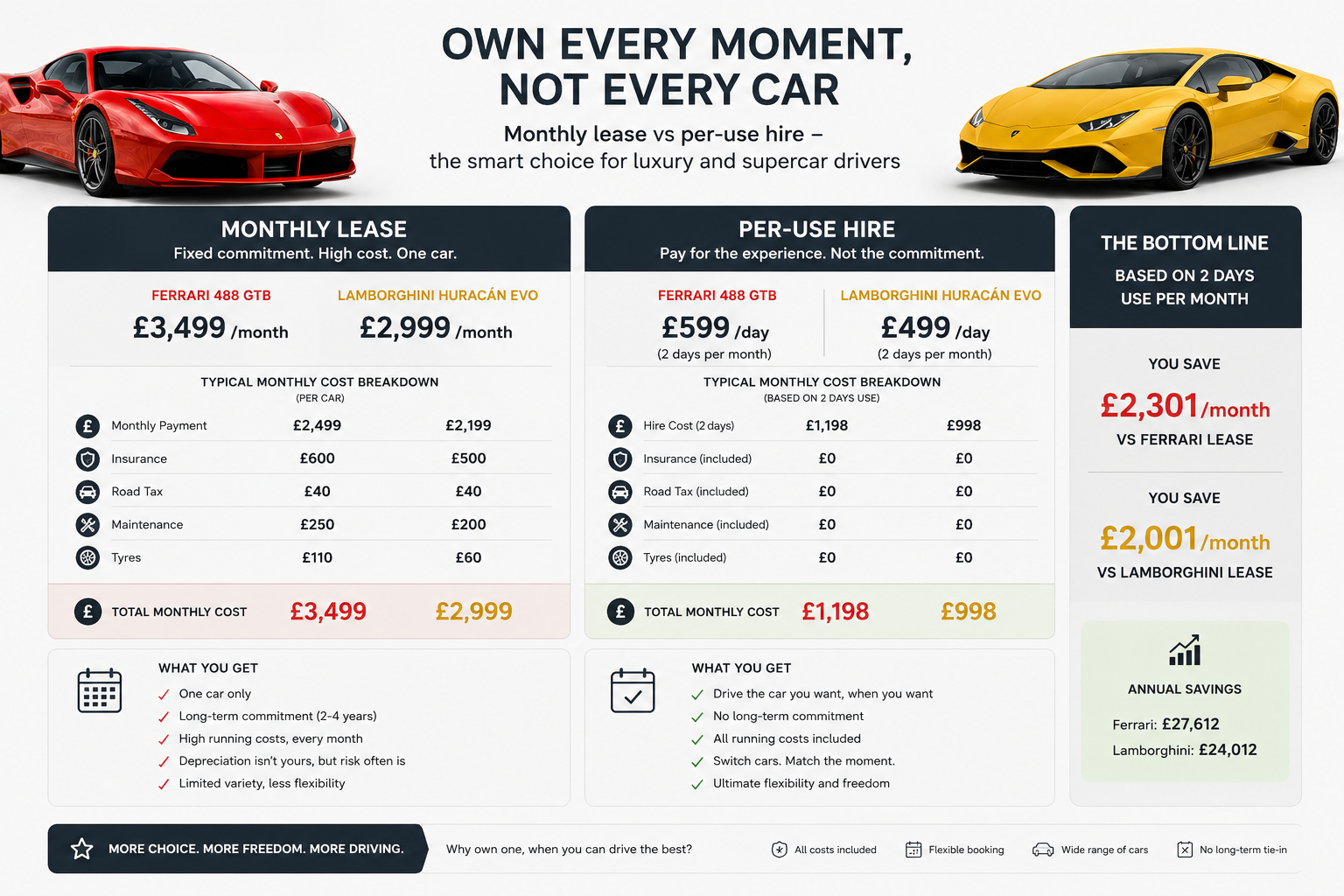
Let's work with real benchmarks.
Leasing a supercar in the UK:
| Car | Monthly Lease (PCH approx.) | Contract Term | Typical Mileage Cap |
|---|---|---|---|
| Porsche 911 Carrera S | £1,800–£2,500/month | 24–48 months | 8,000–10,000 miles/year |
| Aston Martin Vantage | £2,000–£3,000/month | 24–48 months | 8,000–10,000 miles/year |
| Bentley Continental GT | £2,500–£4,000/month | 24–36 months | 6,000–10,000 miles/year |
| Ferrari F8 Tributo | £3,000–£5,000/month | 12–36 months | 5,000–8,000 miles/year |
| Lamborghini Huracán | £2,500–£4,500/month | 12–36 months | 5,000–8,000 miles/year |
Initial rental (deposit) typically 3–9 months' payments upfront. Maintenance usually separate.
Hiring a supercar in the UK:
| Car | Daily Rate | Weekend (2 days) | Monthly (30 days, approx.) |
|---|---|---|---|
| Porsche 911 Turbo | £700–£1,000 | £1,300–£1,800 | £12,000–£18,000 |
| Aston Martin Vantage | £600–£900 | £1,100–£1,600 | £10,000–£16,000 |
| Bentley Continental GT | £700–£1,000 | £1,300–£1,800 | £12,000–£18,000 |
| Ferrari F8 Tributo | £1,000–£1,500 | £1,800–£2,700 | £18,000–£30,000 |
| Lamborghini Huracán | £950–£1,400 | £1,700–£2,500 | £17,000–£25,000 |
Rates approximate. Hire includes insurance and maintenance. Lease does not.
The break-even point is somewhere around 18 months of continuous use. If you want a supercar on your driveway every day for more than a year and a half, leasing becomes meaningfully more cost-effective per day than continuous short-term hire. For anything less than that — including occasional weekend use, special occasions, and annual road trips — short-term hire costs less in total and eliminates commitment risk entirely.
Who Should Lease a Supercar?
Leasing suits a specific type of relationship with a supercar. Here's the honest profile:
You drive regularly and want the car available every day. The Bentley Continental GT that starts every morning and sits on your driveway. The Porsche 911 that you actually commute in. If you want a supercar as a daily-use vehicle rather than an occasional experience, leasing is almost certainly the more economical route.
You have the income to absorb the monthly commitment comfortably. A guide to supercar leasing suggests that a £3,000/month lease makes financial sense at around £20,000/month income — the payment should represent a modest, manageable fraction of your monthly cash flow, not a stretch. Supercar leases are not products to approach as a financial aspiration. They work when they're clearly affordable.
You're comfortable with a specific car for the full term. Leasing means committing to your chosen supercar for two to four years. If you discover six months in that you actually prefer the Ferrari to the Lamborghini, you're facing an early termination fee to exit — typically a significant proportion of the remaining payments. Choose carefully.
Your mileage is predictable. Supercar leases typically cap at 5,000–10,000 miles per year. Excess mileage is charged per mile at the end of the contract. If your supercar use is concentrated in spirited weekends and occasional track days, this can actually work in your favour. If you're tempted to drive it more than the cap allows, the excess charges erode the economic advantage.
You're a VAT-registered business. Business Contract Hire (BCH) for supercars offers the same 50% VAT reclaim on rental payments available for standard luxury cars. For high earners running through a company, the tax efficiency of a business supercar lease can be genuinely significant.
Who Should Hire a Supercar?
Hire suits a completely different profile. Here's who it's genuinely for:
You want the experience rather than daily ownership. Weddings, significant birthdays, milestone anniversaries, stag events, proposals, weekend road trips. These occasions call for the performance, the attention, and the memory — not the depreciation schedule.
You want variety, not commitment. One of hire's genuine advantages over leasing is the ability to drive a different car each time. Ferrari in spring, Lamborghini in summer, Aston Martin for the autumn weekend in Scotland. No lease gives you this. Hire gives you the entire market, one occasion at a time.
Your supercar use is genuinely occasional. If you'd realistically drive a supercar ten to fifteen days per year, the economics of hire are significantly better than the economics of a lease. You're not paying for 350 days you're not using the car.
You don't want a credit agreement. Supercar leases require good credit, proof of income, and affordability checks that can be extensive for high-value vehicles. Short-term hire firms typically check your licence, age (usually 25+), endorsement history, and take a security deposit. No multi-year financial commitment, no long credit file interrogation.
Your plans might change. The single greatest risk of a supercar lease is locking yourself into something your life circumstances subsequently make wrong. A job change, a house move, a changed family situation — any of these can make a long-term supercar lease feel like a commitment you no longer need. Hire has no such exposure.
The Middle Ground: Short-Term Supercar Leasing
There's a growing product in the UK that sits between these two models, and it's worth knowing about.
Short-term supercar lease products — typically one to twelve months — are offered by specialist firms and attempt to combine the economics of leasing with the flexibility of hire. Some of these products include fully comprehensive insurance, low refundable deposits, no credit checks, and short notice periods — functioning more like premium long-term hire than a traditional finance lease.
This product is genuinely useful for:
- People who want a supercar for a season (summer, or a specific project period)
- Those bridging between vehicles — waiting for a new model while not wanting a gap
- Businesses that need a premium car for a defined period without finance complexity
If you're looking at using a supercar regularly for three to six months, this tier is worth exploring specifically before defaulting to either standard hire or a long-term lease.
The Insurance and Maintenance Question
This is where the two options differ significantly in practical terms, and it's often underappreciated when people compare costs.
Short-term hire almost always includes fully comprehensive insurance and professionally maintained vehicles. The daily rate reflects this. You arrive, drive, return. The car is insured, the tyres have been checked, and anything mechanical that goes wrong is someone else's problem and expense.
Supercar leases typically do not include insurance or maintenance in the base monthly payment. You arrange your own insurance — which for a high-value supercar can be substantial — and either pay for servicing separately or add a maintenance package at additional cost. A comprehensive supercar lease with maintenance, insurance, and appropriate cover can add £500–£1,500/month above the headline lease payment.
When comparing monthly lease costs to hire day rates, always factor in the true all-in cost of the lease. The headline monthly payment is rarely the full story.
Head-to-Head: Lease vs Hire at a Glance
| Factor | Supercar Lease (PCH/BCH) | Short-Term Hire |
|---|---|---|
| Typical duration | 12–48 months | Days to a few months |
| Monthly cost | £2,000–£5,000 (car only) | Higher per day; lower if occasional |
| Insurance | Not included (arrange separately) | Usually included |
| Maintenance | Not included (optional add-on) | Usually included |
| Flexibility | Low — early exit fees apply | High — pay per use |
| Credit check | Yes — income/creditworthiness assessed | Light — age, licence, deposit |
| Mileage | Fixed annual cap, excess charges | Daily/weekend allowance, pre-purchasable |
| Variety | One car for the full term | Change car each booking |
| Depreciation risk | None (finance co. owns the car) | None (hire co. owns the car) |
| Best for | Regular daily use, financially comfortable | Occasions, variety, occasional use |
The Decision Framework
One question cuts through the complexity: how many days per year do you actually want to drive a supercar?
- Fewer than 30 days per year → Short-term hire is almost certainly more cost-effective and more flexible
- 30–90 days per year → The economics are genuinely close; compare all-in lease costs vs hire at your specific frequency
- More than 90 days per year (regular daily use) → Leasing is likely the better value proposition, provided the income and credit position support it
And a second question: how certain are you about your next 24–48 months?
If your answer is "very certain," leasing's commitment is manageable. If your answer involves any uncertainty — career, location, family, interests — hire's flexibility is worth considerably more than the cost differential suggests.
Neither leasing nor hiring is the universally superior choice. They're answers to different questions, for different people, at different stages of their relationship with supercar driving. Understanding which one you're actually choosing — and why — is the most valuable thing this comparison can give you.
Ready to compare supercar hire options across the UK? Autofusion lets you browse and compare luxury and exotic car hire across hundreds of rental partners nationwide — so you can find the right car, at the right price, for exactly the kind of driving you have in mind. Explore supercar hire across the UK with Autofusion today.