


Published 21 July 2026
Our methodology focuses on accuracy first.
All information is researched using manufacturer data, official industry guidance, and trusted automotive sources. Where relevant, content is cross-checked against real-world vehicle maintenance practices and common customer enquiries to ensure it is both practical and accurate. Our content is reviewed regularly and updated to reflect changes in regulations, industry standards, and best practices.
The UK supercar market has had an eventful few years. Prices that seemed impossible in 2020 became normal by 2022, then unusual things started happening to used values as the post-pandemic frenzy cooled, and by 2026 the picture is one of the most interesting in recent automotive history.
If you follow this market — as a prospective buyer, as someone who hires supercars and is curious about the vehicles they're sitting in, or simply as an interested observer of the economics of extraordinary machines — the current landscape rewards understanding. There's genuine opportunity at one end of the price spectrum, genuinely extraordinary value at another, and some cautionary tales scattered throughout.
This guide maps all of it.
The Headline: Supercar Prices Are Up About 30% Since 2021
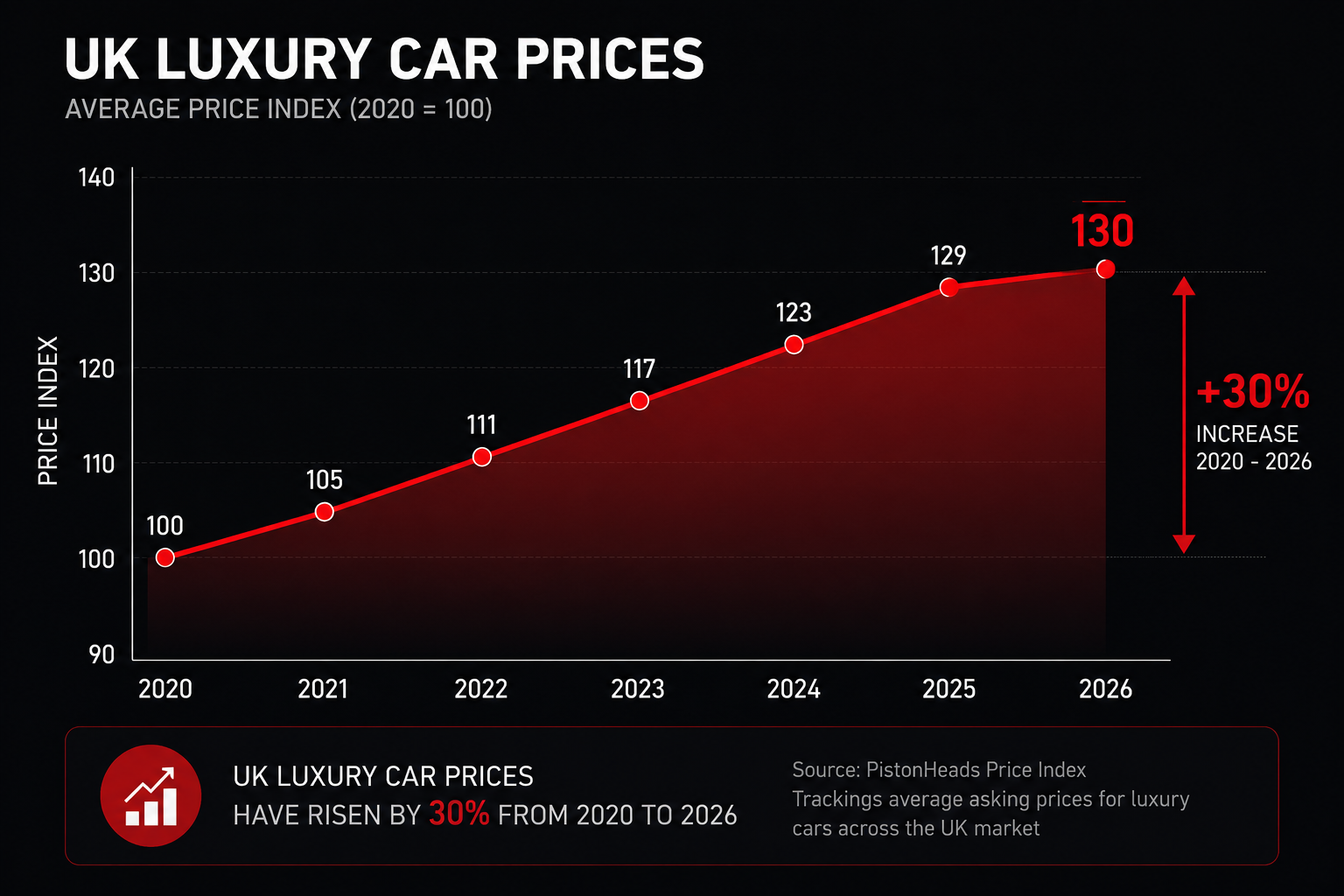
Let's start with the most important number. UK luxury car prices have risen approximately 30% since 2021, with the average price of luxury cars financed rising from approximately £66,000 to approximately £92,000 over a four-year period.
This figure reflects several overlapping factors:
Supply chain disruption: The global chip shortage and manufacturing delays of 2021–2022 reduced new car supply dramatically, pushing buyers toward used markets and inflating prices across the board.
Post-pandemic demand surge: Pent-up leisure and luxury spending released simultaneously into a constrained supply environment — exactly the conditions for rapid price inflation.
Inflation: Consumer price inflation through 2022–2023 pushed up costs across the entire automotive supply chain — materials, labour, logistics — and those increases have been passed to buyers.
Strong underlying demand: The UK supercar ownership fleet hit a record 23,323 high-performance vehicles in 2024, up 4% year-on-year. This represents sustained and growing appetite for extraordinary cars that keeps the pricing floor firm.
The result: even as the acute post-pandemic supply shock has eased, prices have not returned to pre-2021 levels. The new baseline is significantly higher than the old one.
The Split Market: New vs Used in 2026
The most important structural observation about UK supercar prices in 2026 is that the market has bifurcated into two very different stories.
New supercars: Prices have never been higher. Flagship models from Ferrari, Lamborghini, and McLaren are commanding list prices — and waiting-list premiums — that would have seemed extreme even five years ago. The Ferrari 296 Speciale is priced from approximately £360,000. The Lamborghini Aventador Ultimae was allocated before most buyers could even enquire. This end of the market reflects genuine scarcity, exceptional demand, and a brand value that gives manufacturers pricing power they use without apology.
Used supercars: A more nuanced story. The 2021–2022 used car bubble pushed values to inflated levels that have partly — but not fully — corrected. Many used supercars are now offering genuine value relative to their original purchase prices and relative to equivalent new models.
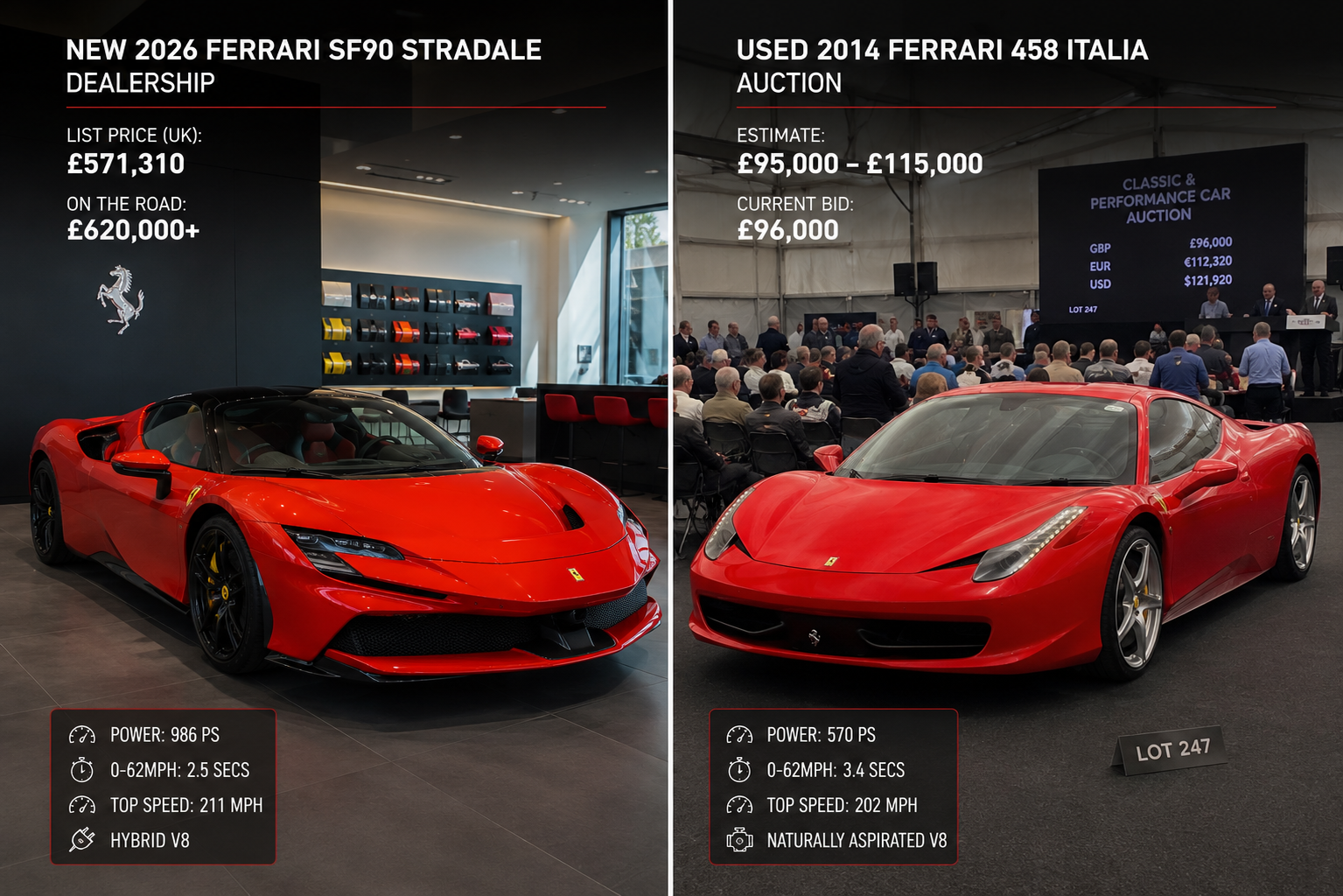
The gap between what a new Ferrari 296 GTB costs and what a used Ferrari 458 Italia costs is significant. Both are exceptional driving experiences. Only one requires anything near the same financial commitment.
The Best-Value Used Supercars in the UK Right Now
The correction in used supercar prices has created a remarkable landscape of accessible performance. Here's how the current UK market looks across price bands:
| Price Band | What's Available | Representative Examples |
|---|---|---|
| Under £35,000 | True supercar performance in older packages | Lotus Esprit V8, older Dodge Viper, early Audi R8 V8 |
| £35,000–£55,000 | Performance icon territory | Nissan GT-R (R35), McLaren MP4-12C, Ferrari F430 |
| £55,000–£100,000 | Modern classic territory | Audi R8 V10, Ferrari 458 Italia, McLaren 650S |
| £100,000–£200,000 | Contemporary near-flagship performance | McLaren 650S Spider, Aston Martin Vantage V12, Ferrari F8 |
| £200,000+ | Current-generation and special editions | McLaren 750S, Ferrari 296 GTB, Lamborghini Huracán |
The most consistently cited "best value" territory for UK buyers in 2026 is the £55,000–£100,000 bracket, where cars like the Audi R8 V10, Ferrari 458 Italia, and McLaren 650S offer modern supercar performance and driving quality at prices significantly below their original list prices.
The Cars That Have Held Value — and Those That Haven't
Not all supercars have moved in the same direction. Understanding which models have demonstrated price resilience and which have softened helps both buyers and hirers.
Value Holders
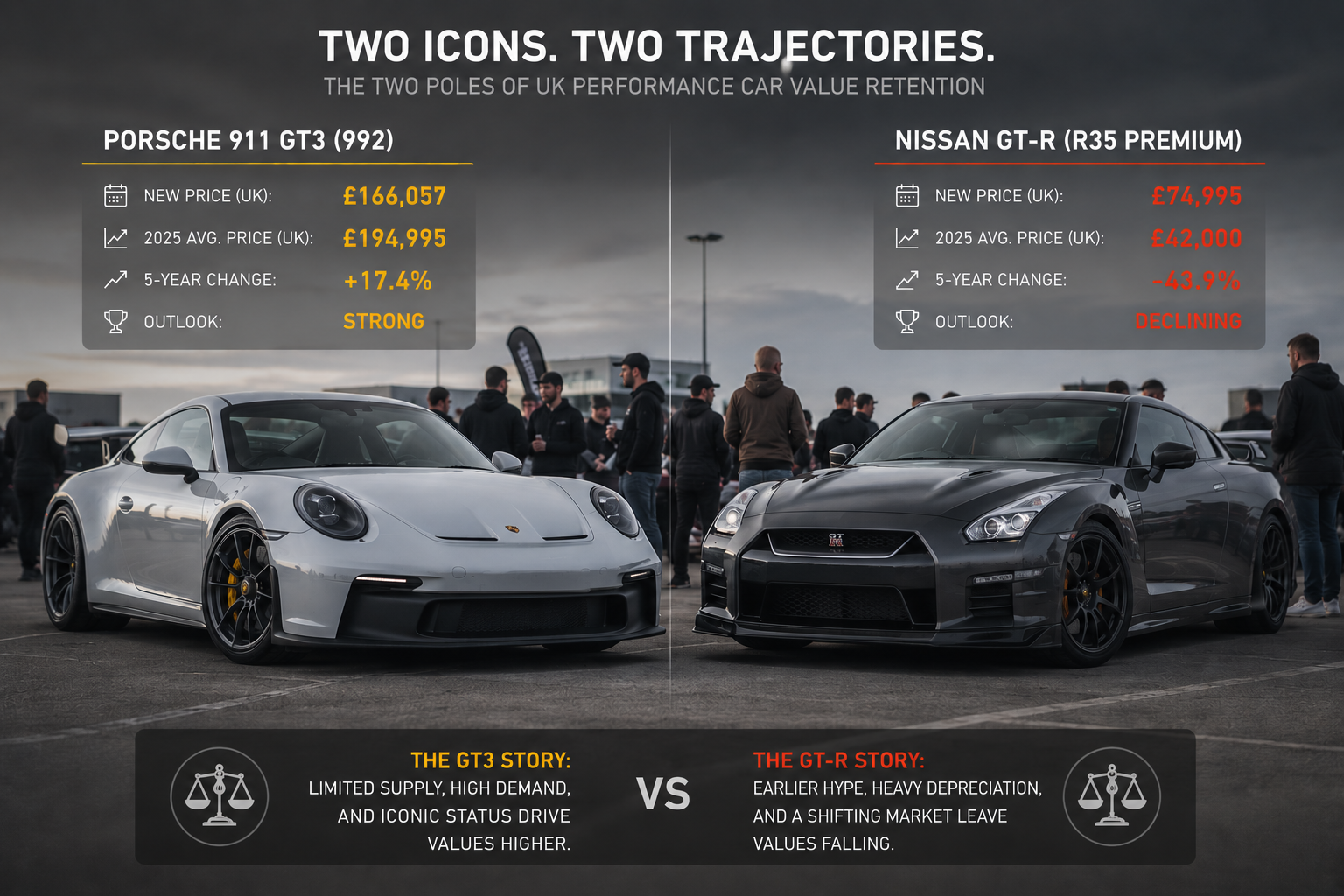
Porsche 911 GT3 (all generations): The GT3's demand has outpaced supply at every stage of its lifecycle. Three-year retained value of approximately 69% makes it the strongest value-retaining performance car in the UK market. Early 997 GT3s have held firm; newer 992 GT3 examples are trading at or above list.
Ferrari 458 Italia: A genuinely special car — the last naturally aspirated mid-engine V8 Ferrari before the twin-turbo era — and buyers know it. Values have stabilised firmly and some well-specified examples have appreciated. The 458 Speciale commands an even higher premium.
Lamborghini Aventador (special editions): The SVJ, Ultimae, and Centenario have all held exceptional values. Base Aventador S values have softened somewhat but remain resilient relative to the broader market.
Ferrari LaFerrari / Aperta: At the collector tier, these have only moved in one direction.
Notable Softeners
Nissan GT-R (R35): This is perhaps the most dramatic price story in the accessible performance segment. Originally priced at approximately £70,000 new, UK examples from 2009–2015 are now available from approximately £35,000–£55,000 — a significant drop from peak 2022 values. For buyers seeking genuine supercar-rivalling performance at sports car prices, the GT-R now represents extraordinary value.
McLaren MP4-12C: New prices exceeded £168,000; used examples now trade from approximately £55,000–£80,000 depending on specification and service history. Early reliability concerns suppressed values more than the car's genuine ability deserves.
Maserati Quattroporte and Granturismo: The Maserati brand's used-value challenges have been documented extensively — buyers can access what was a £100,000+ flagship at deeply discounted used prices, though with commensurately elevated running cost expectations.
How Interest Rates and Inflation Have Shaped the Market
The macroeconomic environment of 2022–2024 left visible marks on UK supercar pricing that are worth understanding.
The interest rate effect: When the Bank of England raised rates to combat inflation, the monthly finance cost of supercar acquisition rose significantly. PCP payments on a £200,000 car at 6–7% interest are meaningfully higher than the same deal at 2–3% from 2021. This reduced the pool of buyers who could finance at the required monthly outlay, exerting downward pressure on used prices in the £100,000–£250,000 range.
The "cash buyer" preservation: At the top end of the market — cars above £300,000 — buyers are predominantly cash purchasers for whom interest rates are largely irrelevant. This segment has therefore maintained its pricing more robustly than the finance-dependent mid-market.
Supply chain normalisation: As manufacturing and parts supply chains stabilised through 2023–2024, new car availability improved from the constrained levels of 2021–2022. This eased some of the pressure that had inflated used prices by reducing the wait for new alternatives.
Hybrid and EV Supercars: How They're Affecting Prices
The electrification of the supercar segment is creating new pricing dynamics that didn't exist five years ago.
The new model premium: Hybrid supercars — Ferrari 296 GTB, SF90 Stradale, McLaren Artura — command prices that reflect both their performance credentials and their technological complexity. The SF90's £400,000+ pricing reflects a level of performance that previous Ferrari generations couldn't approach at any price.
The pure-petrol premium: Paradoxically, the transition toward electrification has increased the desirability and value of naturally aspirated pure-petrol supercars — particularly the Ferrari 458 Italia and Lamborghini Gallardo — among enthusiasts who specifically value the analogue character these cars deliver. The knowledge that such cars won't be replaced with equivalents drives collector demand.
EV performance cars: The Rimac Nevera (priced at approximately £2 million new) represents the extreme end of electric supercar pricing. The Porsche Taycan Turbo S and equivalent platforms represent a growing electric performance tier at £100,000–£200,000 that is establishing its own value trajectory — still too new for reliable used price trend data.
Classic and Young-Timer Supercars: Are They Still Climbing?
The "young-timer" category — supercars from the 1990s through early 2010s that have appreciated significantly over the past decade — has presented a mixed picture in 2026.
Still climbing:
- Ferrari F355 and 360 Modena (particularly open versions) — ongoing appreciation driven by purity of driving experience
- Porsche 911 (996 generation, particularly GT3 and GT3 RS variants) — market re-evaluation has seen 996 GT3 values rise significantly after years of undervaluation
- Lamborghini Diablo — rarity and V12 drama driving continued appreciation
- Classic McLaren F1 — the apex collector car; values are in nine figures for the best examples
Cooling or stabilising:
- BMW i8 — the hybrid pioneer is now demonstrating more predictable used-car dynamics
- First-generation Audi R8 — broadly available and softening from peak values, now occupying genuine value territory
Is Now a Good Time to Buy a Used Supercar in the UK?
This is the question the entire guide builds toward, and the honest answer depends on your priorities.
For value buyers: The £35,000–£100,000 band is arguably the best it's been in several years. The GT-R, older R8, Ferrari F430, and McLaren MP4-12C all offer exceptional performance at prices that reflect meaningful correction from 2022 peaks. If you're shopping in this territory with a clear understanding of the running costs, 2026 is a favourable environment.
For investment buyers: The best opportunities remain at the collector tier — naturally aspirated special editions and limited-production models that the market recognises as finite. The Ferrari 458 Speciale, GT3 RS variants, and similar cars continue to command premium positioning and show appreciation potential.
For anyone considering new: List prices for current-generation flagship supercars are at historic highs, and delivery times for the most desirable models extend to years. The used market for previous-generation equivalents offers compelling alternatives.
How to Track UK Supercar Price Trends
For buyers and enthusiasts who want to monitor specific model values:
| Resource Type | What It Shows |
|---|---|
| Online classifieds (AutoTrader, PistonHeads) | Current asking prices for live listings |
| Car price guide sites | Average advertised prices by model and year |
| Specialist platforms (CarGurus, Motorway) | Market-level data including price trend graphs |
| Specialist sports/classic tracking tools | Sold prices from auction and private sales across multiple platforms |
| Auction results (Bonhams, RM Sotheby's for premium) | True achieved prices for special and rare examples |
The distinction between asking price and achieved price is important in the supercar market. Ambitious asking prices on classifieds can misrepresent the actual market clearing level. Auction results and sold-price databases give the most accurate picture of where the market actually is.
What Price Trends Mean for Hire Rates
The connection between supercar ownership prices and hire rates is direct: hire operators maintain depreciating assets, and the cost of those assets is reflected in daily hire rates.
When used supercar values rose 30%+ from 2021 to 2023, the replacement cost of hire fleet vehicles rose correspondingly — and hire rates increased to reflect that. As used prices have softened in some segments, the pressure on hire rates has eased slightly, but the ongoing increase in insurance costs and operational complexity means hire rates remain firm.
For hirers, understanding the underlying price market helps explain why rates are structured the way they are — and why some vehicles (those with particularly strong retained values, like the Porsche 911 GT3) command premium hire rates that reflect their market scarcity.
Final Thoughts: A Market Worth Watching
The UK supercar price market in 2026 is genuinely fascinating — a split between record-high new car prices, a softened but value-rich used market, and a tier of collector cars that continues to appreciate with apparent indifference to macroeconomic conditions.
The opportunity for informed buyers has rarely been better in the £50,000–£150,000 range. The challenge for prospective new-car buyers is the reverse — extraordinary machines available at extraordinary prices, often with wait lists that test patience beyond what most buyers find comfortable.
And if the ownership proposition feels complex, the hire market remains the clean, uncomplicated alternative: access the car, return the car, and let someone else navigate the price trends.
Want to experience the UK supercar market from the driver's seat rather than the buyer's spreadsheet? Compare vehicles and prices from hundreds of hire partners across the UK with Autofusion — and drive the car without the market timing.