


Published 23 July 2026
Our methodology focuses on accuracy first.
All information is researched using manufacturer data, official industry guidance, and trusted automotive sources. Where relevant, content is cross-checked against real-world vehicle maintenance practices and common customer enquiries to ensure it is both practical and accurate. Our content is reviewed regularly and updated to reflect changes in regulations, industry standards, and best practices.
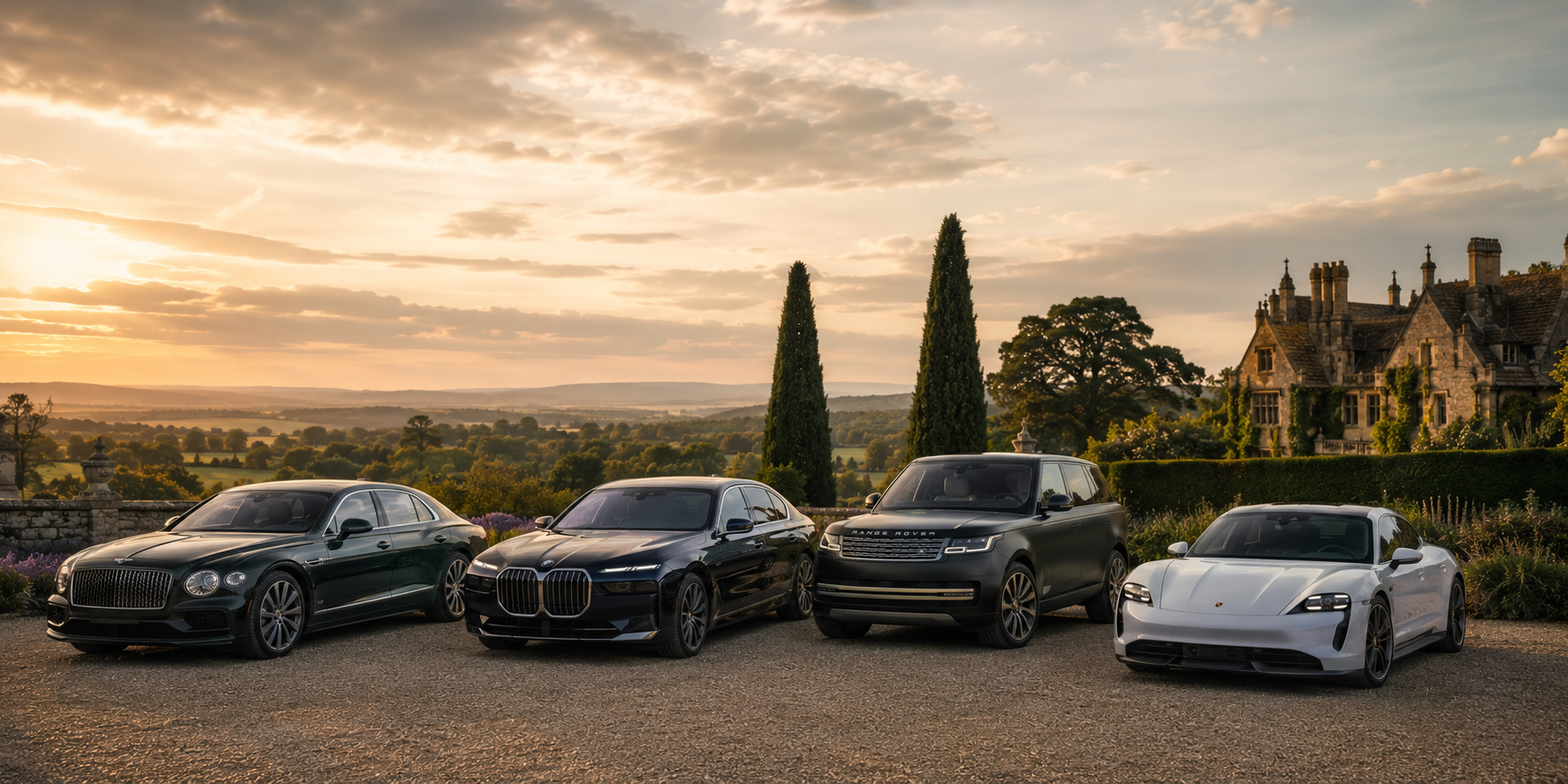
There's a particular kind of industry that operates largely below the radar of conventional economic commentary — one that is simultaneously enormous in financial terms, globally prestigious, and relevant to considerably more people than those who participate in it directly. The UK luxury car market is that industry.
It employs tens of thousands of people. It exports billions of pounds of goods. It sets design and technology trends that filter down to mass-market cars over the following decade. And it tells us something real about the state of aspiration, wealth, and consumer culture in modern Britain.
This guide gives you the complete picture: the size of the market, the trends reshaping it, the brands that matter, and where it's heading over the next decade.
How Big Is the UK Luxury Car Market?
Let's start with scale, because the numbers are more substantial than most people realise.
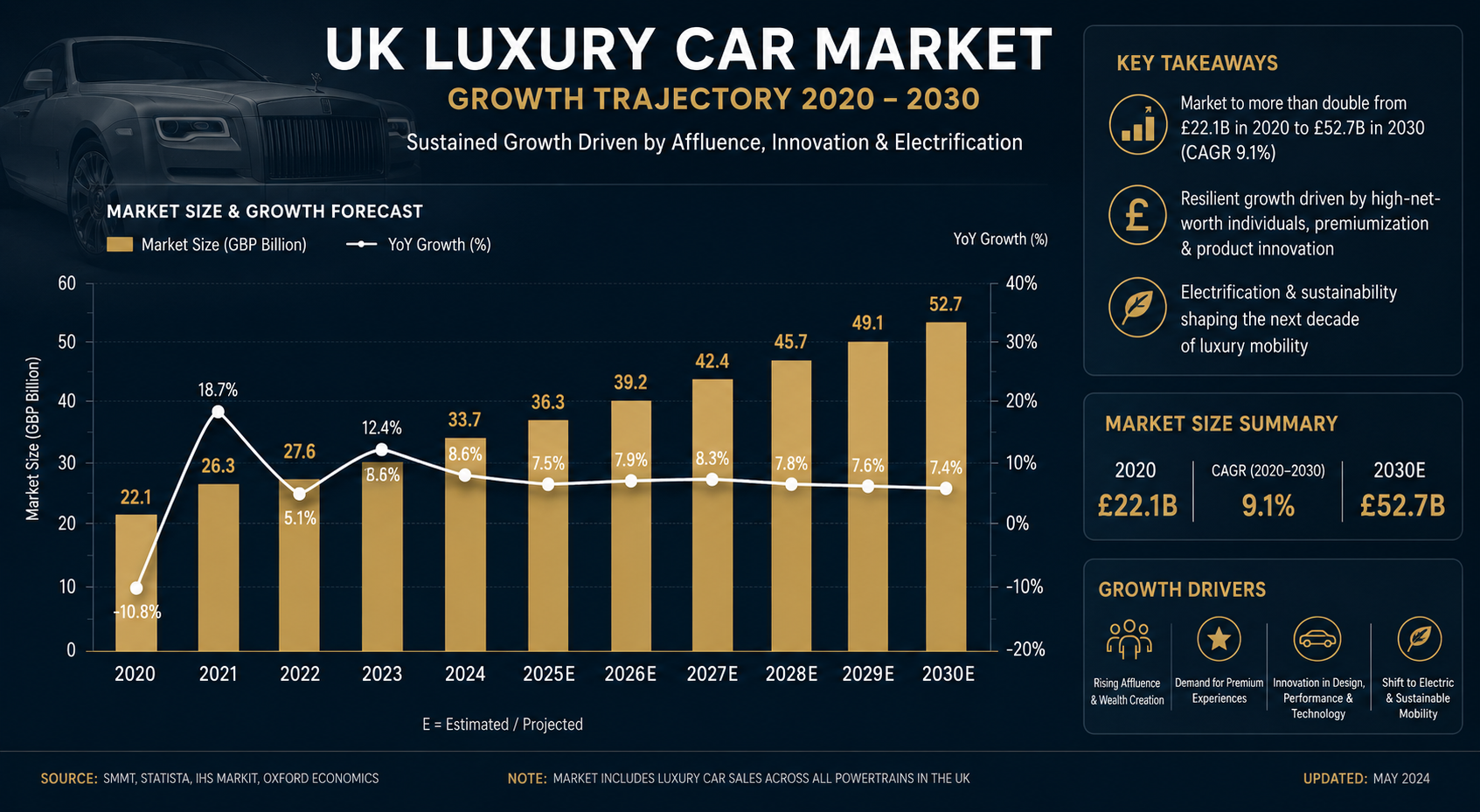
The UK luxury car market was valued at approximately USD 97.19 billion in 2024. By 2030, it is projected to reach USD 142.86 billion — a compound annual growth rate of approximately 6.6%. A longer-range forecast projects USD 150.7 billion by 2033.
This isn't a niche. It's one of the most significant segments of the UK's broader consumer economy, sitting at the intersection of manufacturing, finance, lifestyle, and international trade.
The growth drivers:
- Rising disposable incomes and wealth concentration among the UK's high-net-worth population
- Status appeal that remains remarkably durable across economic cycles
- Technology adoption — luxury cars function as rolling demonstrations of the latest automotive engineering
- The shift toward electric and hybrid vehicles opening new categories of luxury positioning
Which Segments Are Driving Growth?
The UK luxury car market isn't uniform — it's divided into segments with very different growth profiles.
| Segment | Current Status | Growth Direction |
|---|---|---|
| Luxury SUVs | Largest revenue-generating segment | Strong growth |
| Supercars and performance cars | Strong, record ownership numbers | Growing |
| Luxury electric vehicles | Expanding, but below early forecasts | Moderate growth |
| Large luxury saloons | Declining share, premium segment pressure | Flat to declining |
| Sports GT (coupe, convertible) | Stable, niche | Steady |
| Ultra-luxury (Rolls-Royce, bespoke) | Resilient, price-driven | Growing by value |
The SUV dominance story: SUVs have become the largest revenue-generating vehicle type in the UK luxury segment, and the trend shows no sign of reversing. The combination of practicality, elevated ride height, and the ability to carry both luxury cues and genuine performance has made the luxury SUV the format that luxury brands have all converged on — Bentley (Bentayga), Ferrari (Purosangue), Lamborghini (Urus), Aston Martin (DBX), Porsche (Cayenne/Macan), Rolls-Royce (Cullinan).
The supercar resilience story: The UK had a record 23,323 high-performance vehicles registered in mid-2024, up 4% year-on-year. This sustained growth in supercar ownership reflects both the underlying wealth of the UK buyer base and the expanding appeal of extraordinary performance cars to a broader demographic.
How Luxury Car Prices Have Changed
The UK luxury car market has experienced significant and sustained price inflation since 2021. The most reliable data point: the average price of luxury cars financed in the UK rose from approximately £66,154 in 2021 to £92,044 in 2025 — a 30% increase in four years.
This isn't just inflation. It reflects:
Supply chain disruption: The 2021–2022 chip shortage and manufacturing constraints reduced new car supply, pushing buyers toward used markets and inflating prices.
New model launches in premium SUV category: The introduction of Bentley Bentayga II, Aston Martin DBX, Ferrari Purosangue, and the new Rolls-Royce Cullinan lifted the average price ceiling of the pre-owned luxury SUV market. Pre-owned luxury SUV average prices rose from approximately £82,523 in 2020 to £126,480 in 2025 — a 53% increase.
Premium pricing power: At the top of the market, brands with genuine scarcity (limited-edition Ferrari, bespoke Rolls-Royce, special Lamborghini variants) have demonstrated exceptional pricing power, with customers accepting price points that would have seemed extraordinary even five years ago.
The Electrification Transformation
The single most significant structural change in the UK luxury car market is electrification — and the reality in 2026 is more nuanced than either the EV optimists or the ICE defenders predicted.
The headline: Internal combustion engines continue to dominate luxury car financing. Data from specialist finance providers shows that petrol-powered vehicles account for approximately 85% of all luxury vehicles financed in the UK, representing a clear signal that EV uptake in the luxury segment has slowed significantly from the trajectory projected in 2020–2022.
The nuance: This doesn't mean EVs are irrelevant — it means the transition is taking longer and the market is more heterogeneous than early projections assumed.
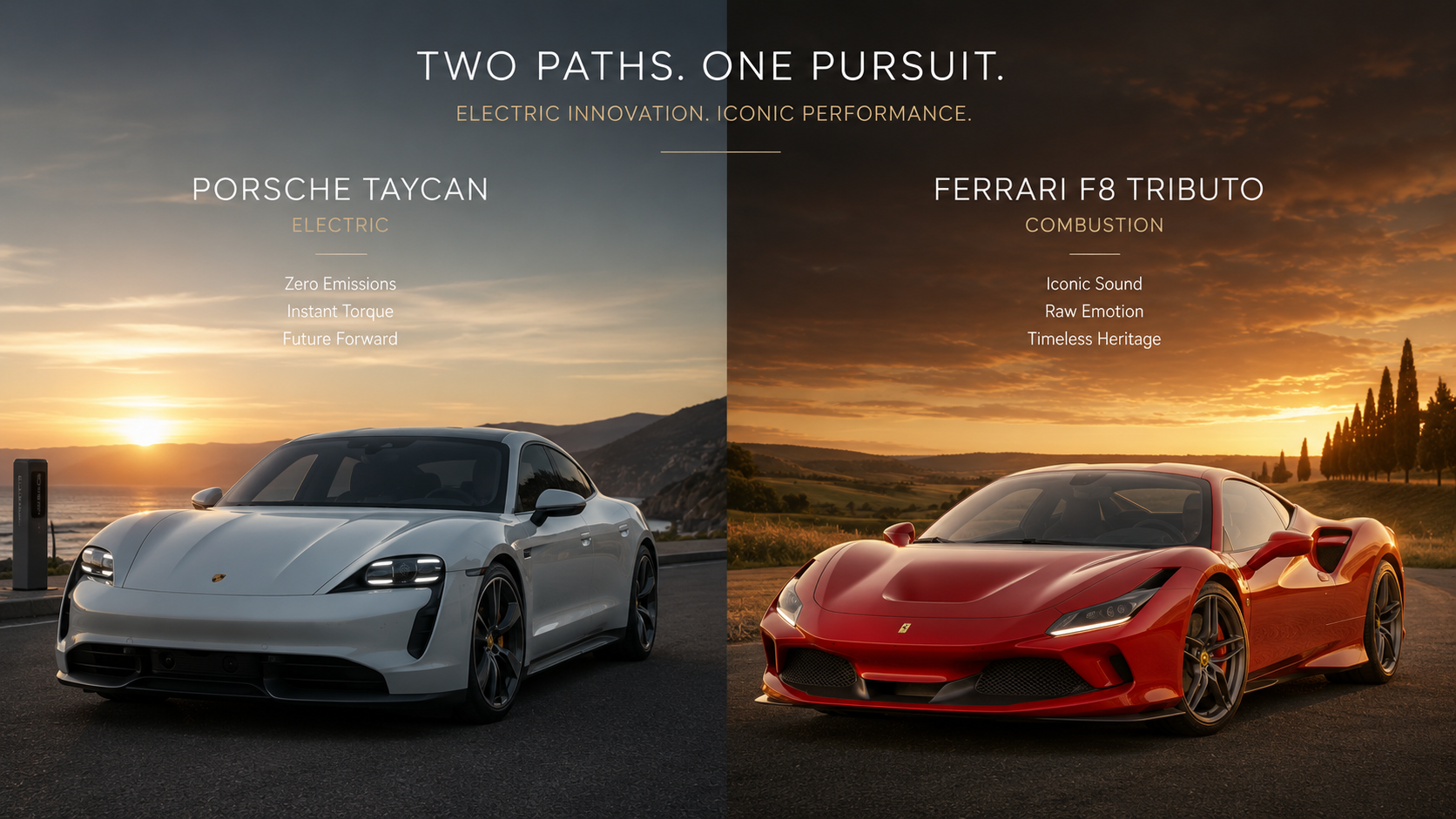
The EV luxury case: The BMW i7, Mercedes EQS, Porsche Taycan Turbo S, and the forthcoming Rolls-Royce Spectre represent genuine luxury electric vehicles with real appeal to a specific buyer profile — environmentally motivated, technology-oriented, and often urban-based.
The ICE resurgence: Simultaneously, there is measurable and growing demand for the last generation of naturally aspirated, pure-combustion performance cars. The Ferrari 458, Lamborghini Gallardo, and equivalent models are appreciating in value precisely because the market recognises they represent a finite resource. This creates a bifurcated luxury market in which EV and ICE coexist for the foreseeable future.
British Luxury Manufacturing: A Market Within a Market
The UK is unusual among major economies in having a cluster of world-leading luxury and specialist car manufacturers of global significance.
The numbers: UK small-volume luxury, high-performance and niche-car manufacturers collectively turn over approximately £5.5 billion annually, exporting nearly £5 billion of high-value products. These businesses support approximately 15,000 direct jobs and an estimated 60,000 in the supply chain.
The brands:
| Brand | Headquarters | Market Position |
|---|---|---|
| Rolls-Royce Motor Cars | Goodwood, West Sussex | Ultra-luxury, global market leader |
| Bentley Motors | Crewe, Cheshire | Luxury GT and SUV, strong global sales |
| Aston Martin | Gaydon, Warwickshire | Performance GT, James Bond brand heritage |
| McLaren Automotive | Woking, Surrey | Pure performance supercars |
| Land Rover / Range Rover | Gaydon, Warwickshire | Luxury SUV global market leader |
These manufacturers are not domestic curiosities — they are globally significant premium businesses that define the market internationally. Rolls-Royce set consecutive annual delivery records in 2023 and 2024. Bentley's Bentayga is the world's best-selling ultra-luxury SUV. The Range Rover is the benchmark for its category worldwide.
The Best-Selling Luxury Cars in the UK in 2026
The specific models that represent the current peak of UK luxury car demand:
| Category | Leading Models |
|---|---|
| Ultra-luxury saloon | Rolls-Royce Ghost, Bentley Flying Spur |
| Luxury SUV | Range Rover, Bentley Bentayga, Rolls-Royce Cullinan, Lamborghini Urus |
| Luxury electric | BMW i7, Mercedes EQS, Porsche Taycan |
| Performance GT | Porsche 911, Bentley Continental GT, Aston Martin DB12 |
| Flagship saloon | Mercedes-Benz S-Class, BMW 7 Series |
| Supercar | Ferrari 296 GTB, Lamborghini Huracán Tecnica, McLaren 750S |
The dominance of SUVs across multiple price points confirms the market data — the SUV format has absorbed a substantial share of the luxury market that large saloons once held, while the traditional luxury saloon (S-Class, 7 Series) has seen its relative market position diminish.
Subscription and Flexible Leasing: Reshaping Ownership
One of the significant structural changes in the UK luxury car market over the past four years is the growth of flexible ownership models. Specialist finance providers recorded a 12% year-on-year increase in flexible leasing and subscription-based models in 2024, with luxury segments making a significant contribution.
This shift reflects changing attitudes among affluent consumers, particularly younger buyers in the 30–45 age bracket who have grown up in a subscription economy and don't approach car ownership with the same permanence that previous generations did.
What this means for the market:
- Easier access to high-end vehicles without the capital commitment of outright purchase
- More frequent model transitions (driving this year's S-Class, next year's i7)
- A growing used-car supply as early-lease returns enter the market at predictable intervals
- Pressure on traditional PCP and HP finance as subscription models offer a competitive alternative
The growth of the hire and subscription sector complements this trend — as more consumers access luxury vehicles on a flexible basis, the psychological and practical barriers to booking an occasional supercar hire continue to fall.
Where UK Luxury Cars Are Bought
The UK luxury car market is geographically concentrated in ways that reflect the distribution of affluence:
| Region | Share of Luxury Car Ownership |
|---|---|
| South East | ~23% |
| London | ~15% |
| West Midlands | ~11% |
| East of England | ~9% |
| Rest of UK | ~42% |
The South East and London together account for approximately 38% of UK luxury car ownership — a significant concentration that reflects the income distribution of the UK economy and the presence of international buyers and financial sector professionals in these regions.
This geographic concentration has direct implications for the hire market, which is correspondingly London-heavy, and for the dealership landscape, which clusters specialist luxury retailers in accessible distance of these markets.
Consumer Trends Shaping Luxury Car Demand
Beyond the macro-economic drivers, several consumer trends are visibly reshaping what luxury car buyers want and expect.
Heritage and brand storytelling: In an era of brand proliferation, established luxury marques are leaning further into their histories. Bentley's 105-year story, Rolls-Royce's association with British excellence, Aston Martin's James Bond cultural identity — these are actively marketed assets, not just background facts. For buyers who want their luxury car to mean something beyond its performance data, heritage brands maintain a powerful advantage.
Technology as luxury: The integration of AI-powered infotainment, semi-autonomous driving features, over-the-air software updates, and connected services has redefined what luxury means in a car. Buyers who would once have specified by engine specification now specify by technology package. The car as mobile office, entertainment system, and digital companion is no longer an aspiration — it's a baseline expectation in the upper luxury segment.
Personalisation: Mass-production luxury is increasingly an oxymoron at the highest price points. Rolls-Royce's Bespoke programme, Bentley's Mulliner division, and Ferrari's Tailor Made service have expanded significantly — buyers want cars that reflect their specific tastes, not a factory standard with a few option codes. This personalisation premium is among the most significant value drivers in the ultra-luxury segment.
Sustainability expectations: Affluent consumers in the UK increasingly evaluate luxury purchases against environmental credentials. This doesn't mean they're all buying EVs — but it does mean that brands that can articulate a credible sustainability narrative have a meaningful advantage with a growing buyer cohort.
How Resilient Is the Luxury Segment to Economic Headwinds?
The honest answer: significantly more resilient than the mainstream market.
During the interest rate rises of 2022–2024, mainstream car sales were meaningfully affected. In the luxury segment, the impact was more muted — not absent, but considerably softer than in volume car markets. The reason is structural: luxury car buyers are disproportionately high-net-worth individuals for whom interest rate changes have less impact on purchasing capacity, and the emotional and status value of the purchase sustains demand through cycles that would suppress mid-market activity.
The UK luxury car market saw consistent growth through the post-pandemic economic turbulence — a period that significantly stressed mainstream car markets, manufacturing supply chains, and consumer confidence more broadly. This resilience is a structural feature of the segment, not a temporary anomaly.
The UK Luxury Car Market to 2030 and Beyond
Four trends will define the UK luxury car market between now and 2030:
1. The 2035 ICE ban: The UK government's plan to end sales of new pure petrol and diesel cars by 2035 is a significant catalyst that is already shaping manufacturer investment, buyer psychology, and residual value calculations across the luxury segment.
2. Electrification of the most aspirational brands: The next major chapter is the electrification of the brands that currently define luxury most clearly. Rolls-Royce's Spectre is the opening act. How the market receives a fully electric Bentley GT or a hybrid Aston Martin will define the trajectory of ultra-luxury over the next decade.
3. The experience economy: The continued shift toward experiences over ownership will sustain and grow the hire, subscription, and flexible access markets alongside traditional ownership — expanding the effective audience for luxury automotive products.
4. Personalisation and ultra-bespoke: The very top of the market will continue to move toward extreme personalisation, with customers paying significant premiums for vehicles that are genuinely unique rather than simply expensive.
The market heading into 2030 will be more electric, more digitally connected, more personalised, and more experience-oriented than today's. The brands that succeed will be those that manage the transition from internal combustion heritage to electric future without losing the qualities — the emotion, the character, the meaning — that justified the premium in the first place.
Final Thoughts: A Market That Reflects Something Bigger
The UK luxury car market isn't just a market. It's a mirror for the country's relationship with aspiration, technology, heritage, and the complicated negotiations between tradition and progress that characterise British culture at its most interesting.
The cars it produces — from the Rolls-Royce Spectre to the Lamborghini Urus to the Porsche Taycan — are among the most sophisticated objects manufactured anywhere in the world. The market that buys, sells, and increasingly rents them is equally sophisticated, and growing.
Understanding it properly is useful whether you're buying, investing, hiring, or simply curious about one of the more remarkable industries the UK has ever produced.
Want to experience the UK luxury car market from behind the wheel? Compare vehicles and prices from hundreds of hire partners across the UK with Autofusion — and access the market without the ownership commitment.