


Published 11 July 2026
Our methodology focuses on accuracy first.
All information is researched using manufacturer data, official industry guidance, and trusted automotive sources. Where relevant, content is cross-checked against real-world vehicle maintenance practices and common customer enquiries to ensure it is both practical and accurate. Our content is reviewed regularly and updated to reflect changes in regulations, industry standards, and best practices.
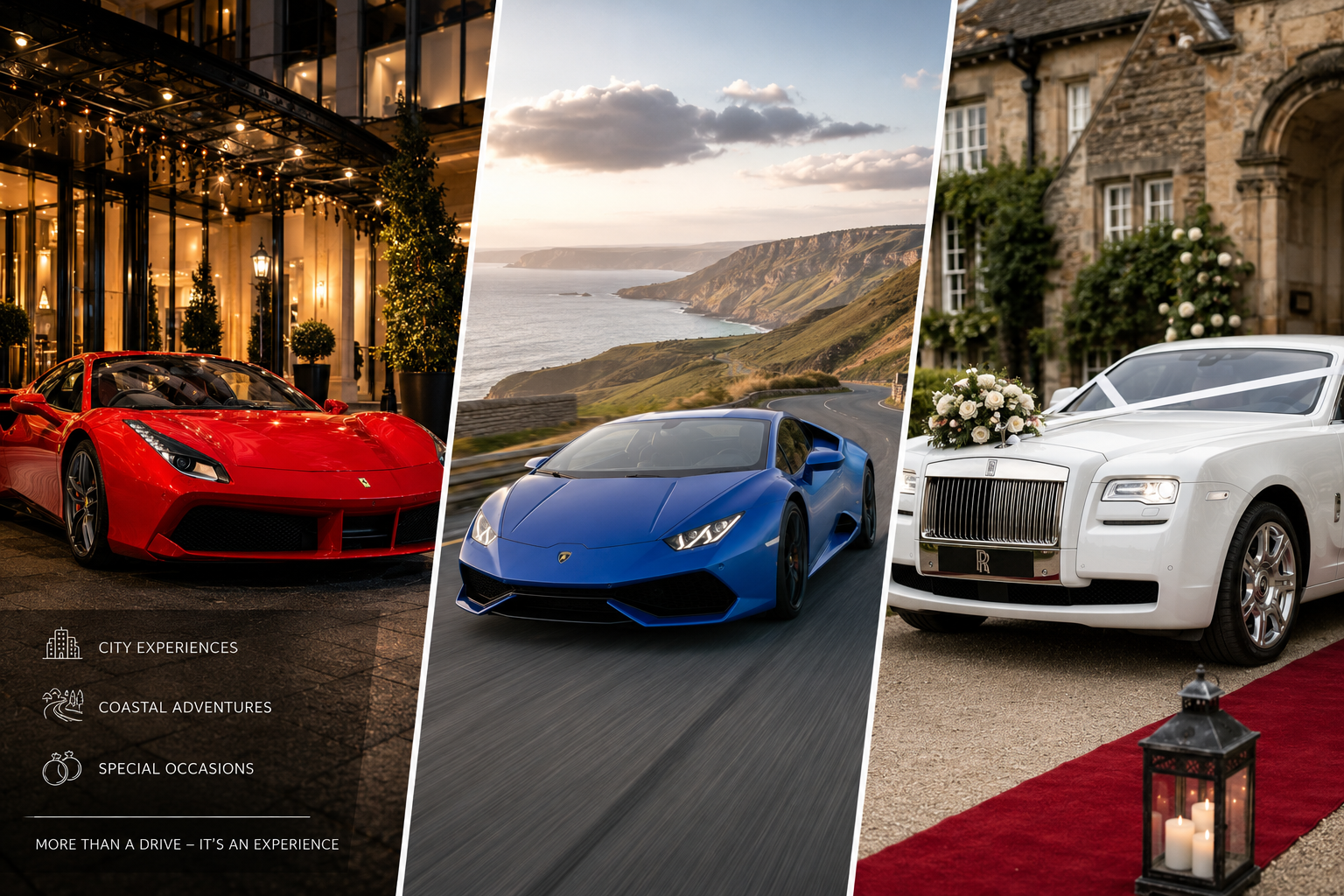
Something interesting has happened in the UK supercar market over the past five years, and it's a shift that deserves more attention than it typically gets.
The number of people who can afford to own a Ferrari has grown modestly. The number of people who want to experience a Ferrari has grown dramatically. And somewhere in the gap between those two trends, an industry has expanded, professionalised, and embedded itself in the mainstream of UK consumer culture in a way that would have seemed optimistic even a decade ago.
Supercar hire in the UK isn't a niche product for the ultra-wealthy anymore. It's a market, and it's growing fast. This piece explains why.
The Numbers First: How Big Is This Market?
Let's ground the narrative in the data before the analysis.
The UK car rental market overall:
- Valued at approximately USD 7.27 billion in 2024
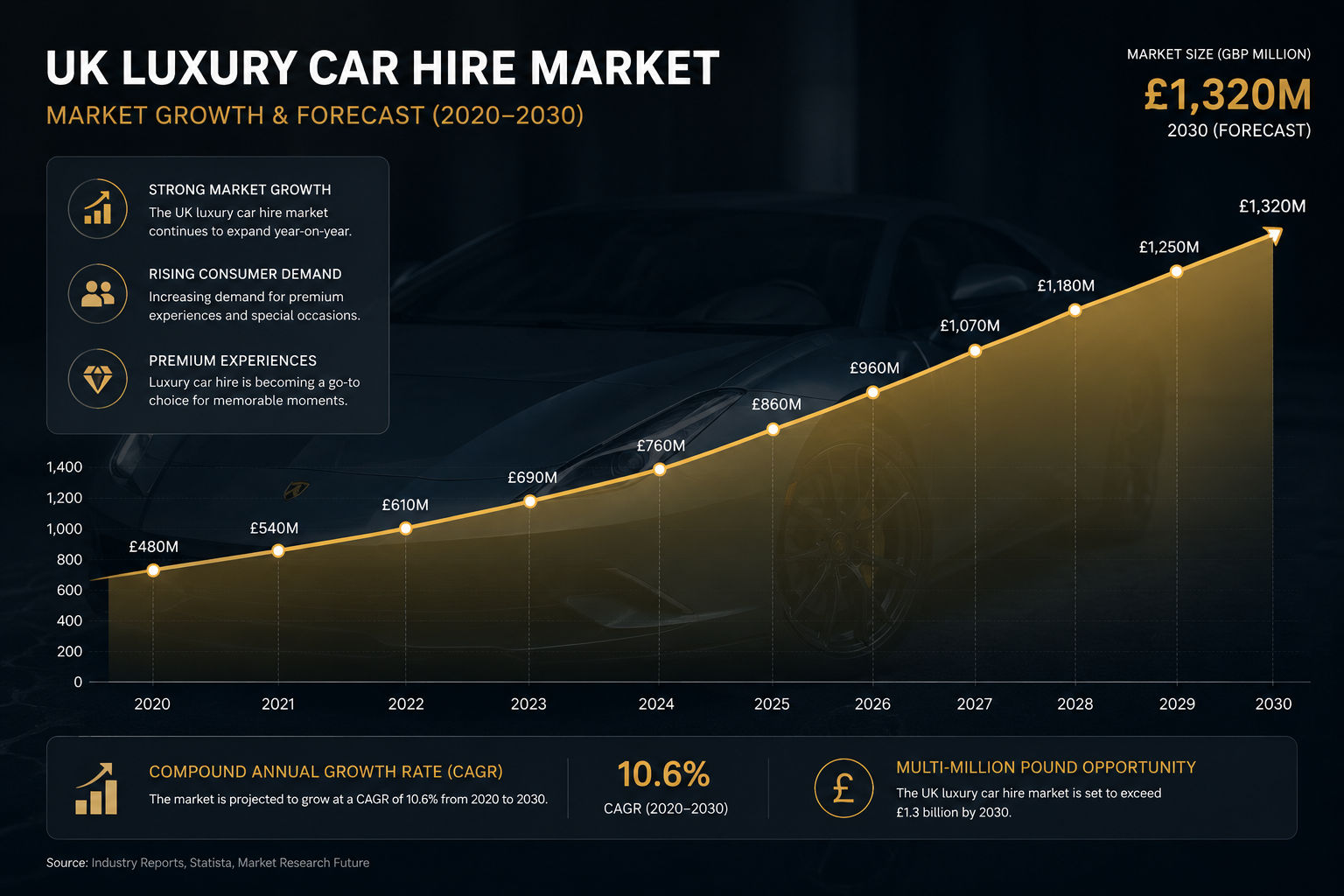
- Projected to reach USD 13.66 billion by 2030 at a 10.8% compound annual growth rate — one of the fastest-growing segments of the UK consumer services sector
- The broader UK car rental and leasing revenue base was growing at approximately 5.8% per annum in the mid-2020s
The luxury segment specifically:
- Luxury and premium car rentals account for approximately 20% of the overall UK rental market — a substantial and growing portion
- Luxury car rental globally is forecast to reach USD 74.41 billion by 2031, up from USD 55.04 billion in 2026, at a 6.22% CAGR
The most striking single data point: One major UK luxury hire operator reported a 38% jump in luxury car hire bookings in early 2026 compared with the same period in 2025. That's not a rounding error — that's a fundamental change in demand behaviour.
The Structural Driver: Access Without Ownership
The most fundamental reason for supercar hire growth in the UK is one of the simplest: the gap between wanting to experience something and being able to afford to own it has become a product category.
Supercar ownership is expensive in ways that extend far beyond the purchase price. Insurance (£4,000–£10,000+ per year), servicing (£2,000–£5,000+ per year), depreciation (£15,000–£30,000+ per year on a Lamborghini Huracán), storage, and the anxiety of maintaining something that costs more than most houses to replace — all of this creates a meaningful barrier to the experience of driving extraordinary cars.
Supercar hire removes all of those barriers. You pay for one day or one weekend. You drive something extraordinary. You return it. No depreciation. No insurance premium. No servicing bill. No depreciation risk.
This model — pay per use rather than ownership — is one of the dominant consumer trends of the 2020s across virtually every premium category. Supercars are simply one of its more spectacular expressions.
The Experience Economy: Why Now?
The UK consumer shift from things to experiences has been well-documented across multiple industries, but the automotive sector crystallises it particularly clearly.
A generation of UK consumers has grown up in a world where you don't need to own music to listen to it, you don't need to own films to watch them, and increasingly, you don't need to own a car to drive an exceptional one. The subscription mindset — access over ownership — has permeated consumer decision-making at every income level.
For the specific segment that supercar hire serves, the experience economy plays out as:
- Bucket list fulfilment: Driving a Ferrari 488 or Lamborghini Huracán is an explicit aspiration for a significant portion of the UK male (and increasingly female) 30–55 demographic. Hire makes that aspiration achievable without a six-figure capital commitment.
- Milestone celebrations: Birthdays, anniversaries, weddings, proms, proposals — events that demand extraordinary rather than adequate — are the occasion market that drives a substantial share of supercar hire bookings.
- Status signalling without status spending: The aspirational context that a supercar creates can be accessed for a day rather than requiring permanent commitment. This democratisation of the luxury experience is a significant social shift.
The Social Media Effect: Instagram, TikTok, and the Visual Economy
It would be naive to discuss supercar hire growth without acknowledging the role of social media — specifically, the way platforms have created both demand for and visibility of extraordinary automotive experiences.
The mechanism is direct:
- UK car influencers (Shmee150, MrJWW, Supercarsoflondon and the broader UK automotive creator ecosystem) have built audiences in the hundreds of thousands by documenting access to — not ownership of — extraordinary cars
- Those audiences see that accessing a Lamborghini for a weekend is something that people like them do, not an exclusive preserve of the ultra-wealthy
- That normalisation of access converts into hire bookings
Online searches for luxury cars increased by approximately 230% between 2019 and 2021 and have sustained significantly higher levels since. Some of that demand converts to ownership. A substantial and growing proportion converts to hire.
For the hire industry specifically, social media has also created a specific demand driver: content creation. Hiring a supercar for a half-day photoshoot or a video production is now a mainstream use case, with content creators across platforms budgeting for car hire the same way they budget for locations or equipment.
The Chauffeur Shift: A Market Within a Market
One of the most significant trends within UK luxury car hire's growth story is the internal shift toward chauffeur-driven services overtaking self-drive.
In key markets — London, Heathrow airport, major city corporate zones — chauffeur-driven luxury car bookings are now growing faster than self-drive bookings. The reasons are structural:
For corporate clients:
- Predictability matters more than driving pleasure
- Arriving at meetings composed and prepared rather than navigated is a functional advantage
- The driver's knowledge of the city and the traffic reduces cognitive load on a working day
For leisure clients:
- The experience of being driven in a Rolls-Royce Phantom is genuinely different from driving one — it's a different service
- For events, celebrations, and occasions, eliminating the driving responsibility allows full enjoyment
- The "turn-key" nature of a chauffeur service (car arrives, driver manages everything) suits the convenience-first consumer orientation of the 2020s
This shift has implications for the market structure: operators who invest in trained, vetted, premium chauffeurs alongside their self-drive fleets are serving the faster-growing segment.
The Record Supercar Fleet: Supply and Demand Combined
It's worth noting that the UK supercar hire market's growth isn't only a demand story — there's a supply element too.
As of mid-2024, the UK had a record 23,323 high-performance vehicles on the road — a 4% year-on-year increase. Ferrari leads this with approximately 14,714 registered cars in the UK, representing consistent growth in the absolute number of extraordinary vehicles available to the market.
This expanding fleet has two effects on hire:
- More vehicles available for operators to add to hire fleets, improving choice and availability for customers
- Higher demand for exceptional vehicles from people who have seen and encountered them more frequently, creating aspirational pull
The UK's position as a world-leading market for luxury cars — driven by London's status as a global financial centre, the strong position of ultra-high-net-worth individuals, and a culture that takes automotive status seriously — creates both the supply and the demand that makes the hire market so healthy.

Tourism and International Travel: An Overlooked Driver
The UK supercar hire market benefits significantly from international tourism and business travel — a factor that often goes under-discussed in domestic market analyses.
London's position as one of the world's premier global cities means that ultra-high-net-worth visitors arriving for business, leisure, or both, naturally seek premium mobility options that match their lifestyle expectations. Heathrow Airport — the UK's primary international hub — is the single most important delivery point for luxury and supercar hire bookings in the UK.
International clients seeking supercar hire in the UK tend to have specific characteristics:
- Higher budget (visiting UK from markets with stronger currencies or higher income levels)
- Less concerned about UK-specific pricing familiarity, which enables premium pricing
- More likely to want chauffeur-driven arrangements (navigating an unfamiliar country)
- More likely to be seeking specific aspirational experiences (driving through the British countryside in an Aston Martin, for instance)
Post-pandemic, international tourism recovery has added meaningful volume to UK luxury hire demand, and operators in London and airport-adjacent markets have benefited significantly.
The New Access Models: Subscriptions, Peer-to-Peer, and Beyond
Traditional daily and weekly hire remains the dominant model, but new access formats are reshaping the edges of the UK supercar and luxury car market.
Car subscriptions (monthly access to a vehicle from a subscription provider) have grown meaningfully since 2021. While the mainstream subscription market focuses on standard and premium vehicles, several UK operators have extended into performance and luxury categories — offering monthly access to a Porsche 911 or an Audi R8 for a fixed monthly fee.
Peer-to-peer platforms (where private owners list their vehicles for hire) have created a secondary market for supercar access — particularly valuable for accessing unusual models, specific specifications, and cars that don't appear in standard hire fleets.
App-based, contactless hire has reduced the friction in booking and collecting luxury vehicles, directly increasing the conversion rate from interest to booking.
These models don't yet dominate the supercar hire market, but they're expanding the addressable market by serving segments — younger hirers, shorter hire windows, specific model requests — that traditional operators don't fully serve.
EV and Sustainability: The Next Growth Frontier
The intersection of sustainability trends and supercar culture is, admittedly, a place of some tension. But the EV revolution is beginning to create genuinely interesting opportunities in the luxury hire market.
The demand signal: A growing segment of affluent UK consumers has made sustainability a factor in purchasing and spending decisions. For these clients, a fully electric luxury vehicle — Tesla Model S Plaid, Porsche Taycan Turbo S, the emerging electric Rolls-Royce Spectre — represents the aspiration of electric performance, not a compromise.
The challenge: The most aspirational supercar hire experiences remain predominantly combustion-powered. A Ferrari V8 or Lamborghini V10 offers a sensory experience that no electric alternative currently replicates. The market for electric supercar hire is real but smaller than environmental trends alone might suggest.
The opportunity: Operators who build hybrid fleets — incorporating high-performance EVs alongside established combustion supercars — position themselves to serve both segments and capture the growth in eco-conscious luxury demand without sacrificing the core market.
Regional Growth: Where Demand Is Strongest
Supercar hire growth is not uniform across the UK. The concentration reflects the distribution of both affluence and tourism:
| Region | Growth Driver | Key Occasions |
|---|---|---|
| London | International tourism, corporate, events | Airport transfers, weddings, events, content creation |
| Heathrow corridor | Airport-based demand | Business arrivals, VIP transfers |
| Manchester | Growing corporate sector, Northern night life | Weddings, events, corporate |
| Birmingham | Events, growing HNW population | Weddings, corporate entertainment |
| Edinburgh / Glasgow | Tourism (domestic and international), events | Weekend hire, weddings, Scottish road trips |
| UK-wide | NC500 and driving route demand | Weekend self-drive, road trip hire |
London and Heathrow represent the largest share of the market by value, driven by the concentration of international demand and corporate accounts. The fastest relative growth, however, is occurring in regional UK markets — particularly Scotland, where the tourism-driven demand for extraordinary driving experiences on extraordinary roads is creating a distinctive hire category.
The Challenges: Why Growth Isn't Without Friction
A growing market doesn't mean an easy market. The supercar hire industry faces genuine structural challenges that temper the growth story.
Insurance: The single largest barrier to entry for new operators and the single largest ongoing cost for established ones. Insuring a fleet of high-value supercars against driver damage, third-party claims, and theft requires specialist underwriters, generates significant premiums, and creates risk exposure that standard motor insurance products don't address.
Damage and excess: The frequency of damage claims — even minor ones — on high-performance vehicles creates operational complexity and cost that directly affects profitability. Operators who manage their client vetting processes tightly (age, licence, driving history) outperform those who don't.
Competition and price pressure: The growth in demand has attracted new entrants, and competitive pricing pressure has emerged in the volume segments of the market (Porsche 911, Audi R8 level). Premium differentiation — fleet quality, service standards, chauffeur training — is increasingly the competitive battleground.
Regulation: As discussed in other guides, the political pressure for tighter regulation of rented supercars is real and may result in additional requirements for operators and hirers over the coming years.
What the Growth Means for Hirers
If you're someone who hires — or is thinking of hiring — a supercar in the UK, the market growth has positive practical implications:
- More choice: Growing fleets mean more models, more specifications, and more operators in more locations
- Better service: Competition drives service quality improvement; the market is progressively more professional
- More accessible pricing: Not everywhere, but in competitive segments, growth is creating more competitive pricing
- More delivery options: Geographic expansion means more operators delivering to more locations
The UK supercar hire market of 2026 is meaningfully better for customers than it was five years ago — more choice, more professional, and serving a wider range of occasions and use cases than the early market ever anticipated.
Final Thoughts: A Market That Has Found Its Moment
Supercar hire in the UK has grown because the conditions for its growth converged simultaneously: the experience economy, the social media visual culture, the access-without-ownership consumer mindset, the expanding international tourism market, and the record number of extraordinary vehicles on UK roads.
The market will continue to grow. The access models will diversify. The regional spread will deepen. And for anyone who has ever wondered what it feels like to pilot a V10 at full chat on a clear morning on the Snake Pass — the answer is more accessible than it has ever been.
That, ultimately, is what growth looks like from the outside. From the inside, it feels like the road and the car and the morning, and everything else disappears.
Ready to experience the UK supercar hire market at its best? Compare vehicles, prices, and operators from hundreds of hire partners across the UK with Autofusion — and find the car that made the market worth building.