



Published 2 June 2026
Our methodology focuses on accuracy first.
All information is researched using manufacturer data, official industry guidance, and trusted automotive sources. Where relevant, content is cross-checked against real-world vehicle maintenance practices and common customer enquiries to ensure it is both practical and accurate. Our content is reviewed regularly and updated to reflect changes in regulations, industry standards, and best practices.

There's a calculation that serious car enthusiasts eventually make. At some point, between the third time you've hired a Lamborghini for a weekend and the first time you've genuinely looked at the purchase price, the question forms properly: is it actually cheaper to own one?
It's a fair question. And the honest answer is more nuanced — and more expensive — than most people expect. Because owning a Lamborghini in the UK isn't just a purchase. It's a financial commitment that extends well beyond the number on the sticker, and the gap between "owning" and "hiring as needed" is narrower than it appears until you model the real numbers.
This guide models the real numbers.
The Total Annual Cost of Owning a Lamborghini in the UK
Let's start with the framework before the individual components. The UK supercar ownership community uses a rough rule of thumb: approximately 10% of the car's value per year in running costs, excluding depreciation. For a Lamborghini Huracán currently valued at around £160,000, that's approximately £16,000 per year in insurance, servicing, tyres, fuel, and miscellaneous costs — before you account for the car losing value.
Add depreciation, and the annual total becomes considerably more significant.
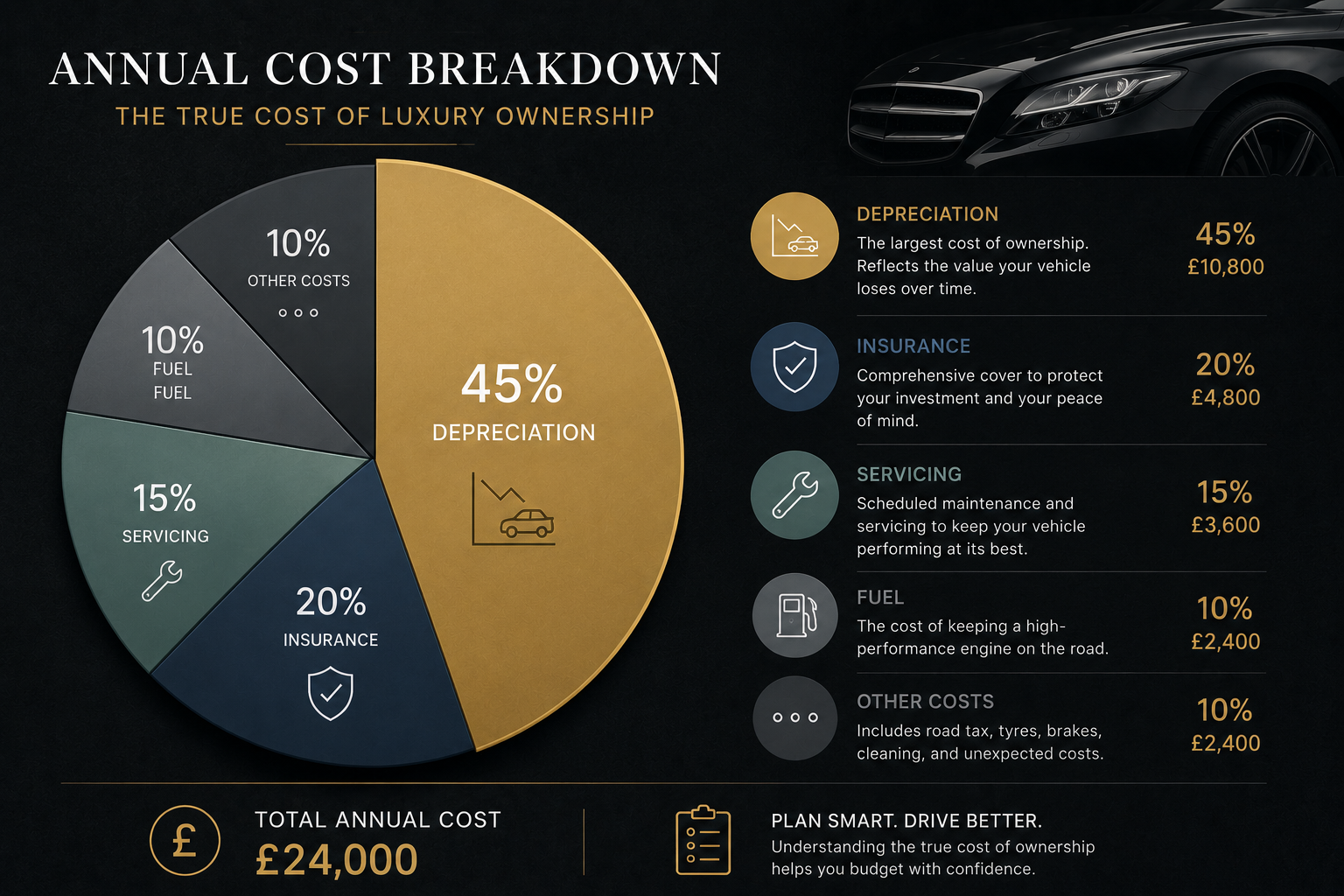
Here's a realistic full-year breakdown for a Lamborghini Huracán Evo in 2026:
| Cost Category | Approximate Annual Cost |
|---|---|
| Depreciation | £15,000–£22,000 |
| Insurance | £4,500–£8,000 |
| Servicing and maintenance | £3,000–£6,000 |
| Tyres (1–2 sets) | £2,000–£4,000 |
| Fuel (8,000 miles at £0.30/mile) | £2,400 |
| Road tax (VED) | £620–£650 |
| MOT and ancillaries | £200–£500 |
| Storage / garage (if required) | £0–£3,600 |
| Total annual cost (including depreciation) | £27,720–£46,750 |
For the Aventador, add approximately 30–50% across most categories. For the Urus, costs are somewhat lower — particularly for insurance and fuel — though depreciation on newer examples can be higher.
Depreciation: The Cost Nobody Likes to Talk About
Depreciation is the single largest cost of Lamborghini ownership in the UK — and the one most people manage to not think about until they come to sell.
The numbers on a Lamborghini Huracán:
A new Huracán at approximately £180,000–£200,000 will typically retain around 85–88% of its value in the first year, implying a depreciation of approximately £22,000–£30,000 in year one alone. As the car ages, annual depreciation tends to slow — but the cumulative loss over a five-year ownership period is substantial.
Factors that affect Lamborghini depreciation in the UK:
- Colour: Standard factory colours (Giallo Belen, Arancio Borealis) tend to hold value better than unusual or polarising specs
- Mileage: High-mileage examples depreciate faster; low-mileage examples can achieve premiums
- Service history: Full Lamborghini service history from main dealer or approved specialist is essential for value retention
- Ad Personam specification: Factory-specced bespoke options can add value; dealer-added modifications can reduce it
- Model cycle position: Cars nearing the end of a model cycle depreciate faster as the replacement approaches
The exceptions: Limited-edition and special series Lamborghinis — Performante, SVJ, Ultimae variants — have historically depreciated less than standard models and in some cases appreciated. But these require premium purchase prices and a degree of market timing that makes them investments rather than simply cars.
Lamborghini Insurance Costs in the UK
Insurance is the most variable annual cost and often the most eye-opening for first-time Lamborghini prospective owners.
Average UK annual insurance by model (2026, typical driver profile):
| Model | Typical Annual Premium Range |
|---|---|
| Lamborghini Urus | £3,000–£6,000 |
| Lamborghini Huracán (standard variants) | £4,500–£8,000 |
| Lamborghini Aventador | £5,000–£10,000 |
These are indicative ranges for experienced drivers (30+, clean record, approved storage). Younger drivers, London postcodes, and high annual mileages command significantly higher premiums. Edge cases — under-25s or drivers with recent convictions — can face premiums exceeding £20,000 per year.
The factors that most affect your premium:
- Age and experience: Under-25s can pay double or triple the standard rates
- Location: London postcodes carry the highest premiums due to crime and accident density
- Mileage: Limiting declared mileage to 5,000–7,000 miles per year reduces premiums
- Storage: A dedicated, alarmed garage can reduce premiums by 20–30% compared with street parking
- Excess chosen: Higher voluntary excess reduces the premium
- Named drivers: Additional named drivers (particularly younger ones) increase premiums
Specialist vs standard brokers: Standard comparison sites rarely return competitive Lamborghini quotes. Specialist supercar insurance brokers — who have dedicated underwriting relationships with specialist insurers — typically achieve meaningfully lower premiums than you'd find on a general aggregator.
Servicing and Maintenance Costs
Lamborghini servicing is not Toyota servicing. The vehicles are extraordinarily engineered, demand extraordinary care, and are maintained by specialist technicians with specialist tools, knowledge, and parts at specialist rates.
The typical service schedule:
- Annual / 9,000-mile service: Oil and filter change, full inspection, fluid checks, software update
- Major service (every 2 years / 18,000 miles): Everything in the annual service plus coolant, spark plugs, air filters, pollen filter, brake fluid, toothed belt inspection (Huracán) or cambelt (Aventador where applicable)
Approximate service costs:
| Service Type | Approx. Cost (Main Dealer) | Approx. Cost (Specialist) |
|---|---|---|
| Annual service | £1,200–£2,000 | £800–£1,500 |
| Major service | £3,000–£5,000 | £2,000–£4,000 |
| Cambelt/toothed belt service | £2,500–£5,000 | £1,500–£3,500 |
Many Lamborghini owners use approved independent specialists rather than main dealers — these are workshops with factory-trained technicians and access to genuine parts, at costs typically 20–40% below main dealer rates. Both approaches maintain service history validity; confirm with your insurer and warranty provider that your chosen specialist is acceptable.
Tyres, Brakes, and Consumables
For high-performance supercars, consumables are a meaningful budget item. This is the category that new Lamborghini owners most consistently underestimate.
Tyres:
The Lamborghini Huracán runs on ultra-wide, low-profile performance tyres in sizes that don't exist anywhere near the budget end of the tyre market. A set of four Pirelli P Zero tyres for a Huracán costs approximately £1,500–£2,500 depending on specification. Driving enthusiasm affects lifespan significantly — rear tyres on a driven Huracán can last as few as 8,000–12,000 miles.
Brakes:
Ceramic composite brakes (optional on most Lamborghinis, standard on performance variants) are extremely expensive to replace — a full replacement set can cost £8,000–£15,000. Standard steel brakes are considerably cheaper but still significantly above standard car prices.
Clutch (manual transmission models):
Single or dual-clutch units on performance cars driven enthusiastically may require replacement before standard mileage thresholds. Budget several thousand pounds for this eventuality.
Fuel Costs: What a Lamborghini Actually Costs to Run
The Lamborghini Huracán's 5.2-litre V10 is not designed with fuel economy as a priority. Official fuel consumption figures suggest approximately 20–22mpg in mixed use; real-world figures for driven examples are often lower.
At current UK petrol prices:
- Cost per mile: Approximately £0.25–£0.35
- Annual fuel cost at 8,000 miles: Approximately £2,000–£2,800
- Cost to fill from empty: Approximately £110–£135 (approximately 87–litre tank, premium unleaded)
The Lamborghini Urus is marginally more economical but still consumes premium unleaded at rates that make a Porsche Cayenne Turbo look efficient.
For comparison: a Porsche Taycan (electric) owned for the same annual mileage would cost approximately £400–£600 in electricity. The V10 experience costs considerably more per mile — but the V10 experience is also the point.
How Model Choice Affects Total Ownership Cost
Not all Lamborghinis cost the same to own. Here's how the three main hire-market models compare:
| Model | Purchase Price (New) | Est. Annual Cost (Incl. Depreciation) | Best For |
|---|---|---|---|
| Huracán Evo | £170,000–£200,000 | £30,000–£45,000 | Best overall balance |
| Aventador S | £280,000–£350,000 | £55,000–£85,000 | Flagship experience, max running costs |
| Urus | £190,000–£250,000 | £35,000–£55,000 | Most practical; lower insurance relative to performance |
The Urus has a meaningfully lower insurance cost profile than the coupes because its size, weight, and SUV characteristics place it in a different risk category with underwriters — despite its 641bhp output.
Finance vs Cash: Monthly Costs Compared
Most UK Lamborghini owners use some form of finance. The most common arrangements:
PCP (Personal Contract Purchase): Typical monthly payment on a Huracán at current rates (assuming a 30% deposit, 4-year term): approximately £2,500–£3,500 per month, with a significant balloon payment at the end.
Hire Purchase (HP): Slightly higher monthly payment than PCP but building toward outright ownership: approximately £3,000–£4,000 per month on similar terms.
Cash purchase: No monthly commitment, but the full capital is deployed immediately and depreciating from day one.
These monthly figures are for the car purchase only — they don't include insurance, fuel, servicing, or tyres. A realistic total monthly cost of Huracán ownership at a modest mileage: £4,000–£6,000 per month all-in, including finance, insurance, fuel, and a servicing reserve.
Ways to Reduce the Cost of Lamborghini Ownership in the UK
The Lamborghini ownership community has developed genuine strategies for managing costs without sacrificing the experience:
1. Limited declared mileage (5,000–7,000 miles per year): Reduces insurance premiums meaningfully and preserves residual value.
2. Secure, climate-controlled storage: An alarmed, locked garage in the right postcode can reduce both insurance premiums and the car's physical condition deterioration. Also removes the risk of the car sitting in cold British weather.
3. Independent specialist servicing: Reputable Lamborghini-specialist workshops typically charge 20–40% less than main dealers for equivalent work using genuine parts.
4. Specialist insurance brokers: Always use a specialist broker rather than a comparison site — the difference in premium can be £1,000–£3,000 per year for the same cover.
5. Extended warranty from day one: Adding an extended warranty package at purchase is significantly cheaper than purchasing retrospectively; it also provides a known annual cost rather than unpredictable repair bills.
6. Buying 2–3 years old: The steepest depreciation occurs in the first 1–2 years. Buying a car that has absorbed that initial depreciation hit reduces your per-year cost and entry price while still delivering a current-generation experience.
The Critical Question: At What Point Is Hiring Cheaper Than Owning?
This is the calculation that changes the conversation. At an annual all-in ownership cost of approximately £35,000–£45,000 for a Lamborghini Huracán, the equivalent hire expenditure would be:
| Hire Rate | Annual Hire Spend Equivalent | Number of Hire Days |
|---|---|---|
| £900/day (weekend rate equivalent) | £35,000 | ~39 days |
| £1,200/day (peak season) | £35,000 | ~29 days |
In other words: if you would realistically drive a Lamborghini for fewer than roughly 30–40 days per year, hiring as needed is financially equivalent to (or cheaper than) ownership — without any of the depreciation risk, storage requirement, insurance complexity, or maintenance burden.
Most Lamborghini owners in the UK who are honest about their usage drive their car between 3,000 and 8,000 miles per year. At 8,000 miles in a year of UK driving — accounting for weather, the school run, sensible restraint on motorways — that's approximately 40–60 meaningful drive days. Ownership begins to justify itself in pure financial terms at that level of use.
For anyone using the car fewer than 20–25 times per year, the numbers make hiring significantly more rational.

The Things Money Can't Quantify
The financial case doesn't capture everything. There are genuine advantages to ownership that hiring can't replicate:
- Familiarity with the car: Knowing your Huracán's dynamics intimately, having built confidence with it over months of ownership, is a different driving experience from hiring a new example each time
- Specification choice: You spec the car exactly as you want it — colour, interior, features — rather than taking what's available
- Availability on demand: Your car is available whenever you want it; hire availability varies
- The asset: Despite depreciation, you hold an asset. It has a residual value. It can be sold.
And equally, hiring has advantages ownership can't match:
- No depreciation risk: You experience the car without absorbing its value loss
- Variety: Different models, different colours, the newest specification each time
- No maintenance anxiety: Nothing is your responsibility when you hand back the keys
- Financial flexibility: The capital isn't locked up in a depreciating asset
Final Thoughts: It's Not About What's Cheaper — It's About What You Actually Want
The honest answer to "should I own or hire a Lamborghini?" is: it depends entirely on how often you'd drive it and what the ownership experience means to you.
If you want to drive a Lamborghini 5 days a year, hire. The economics are clear and the experience is essentially identical.
If you want one in your life — one you know, that you've specced, that's yours — and you'll use it 40+ days per year and can absorb the costs without it being a source of stress, own it. The numbers support it.
If you're somewhere in between: the UK hire market is sophisticated enough that occasional hire can coexist with occasional ownership, or replace it entirely for the kind of extraordinary experience that doesn't need a 365-day commitment.
There is no wrong answer. There are only honest ones.
Not ready to own but want the Lamborghini experience? Compare hire options, models, and prices from hundreds of hire partners across the UK with Autofusion — and drive the car without the annual bill.