


Published 12 May 2026
Our methodology focuses on accuracy first.
All information is researched using manufacturer data, official industry guidance, and trusted automotive sources. Where relevant, content is cross-checked against real-world vehicle maintenance practices and common customer enquiries to ensure it is both practical and accurate. Our content is reviewed regularly and updated to reflect changes in regulations, industry standards, and best practices.
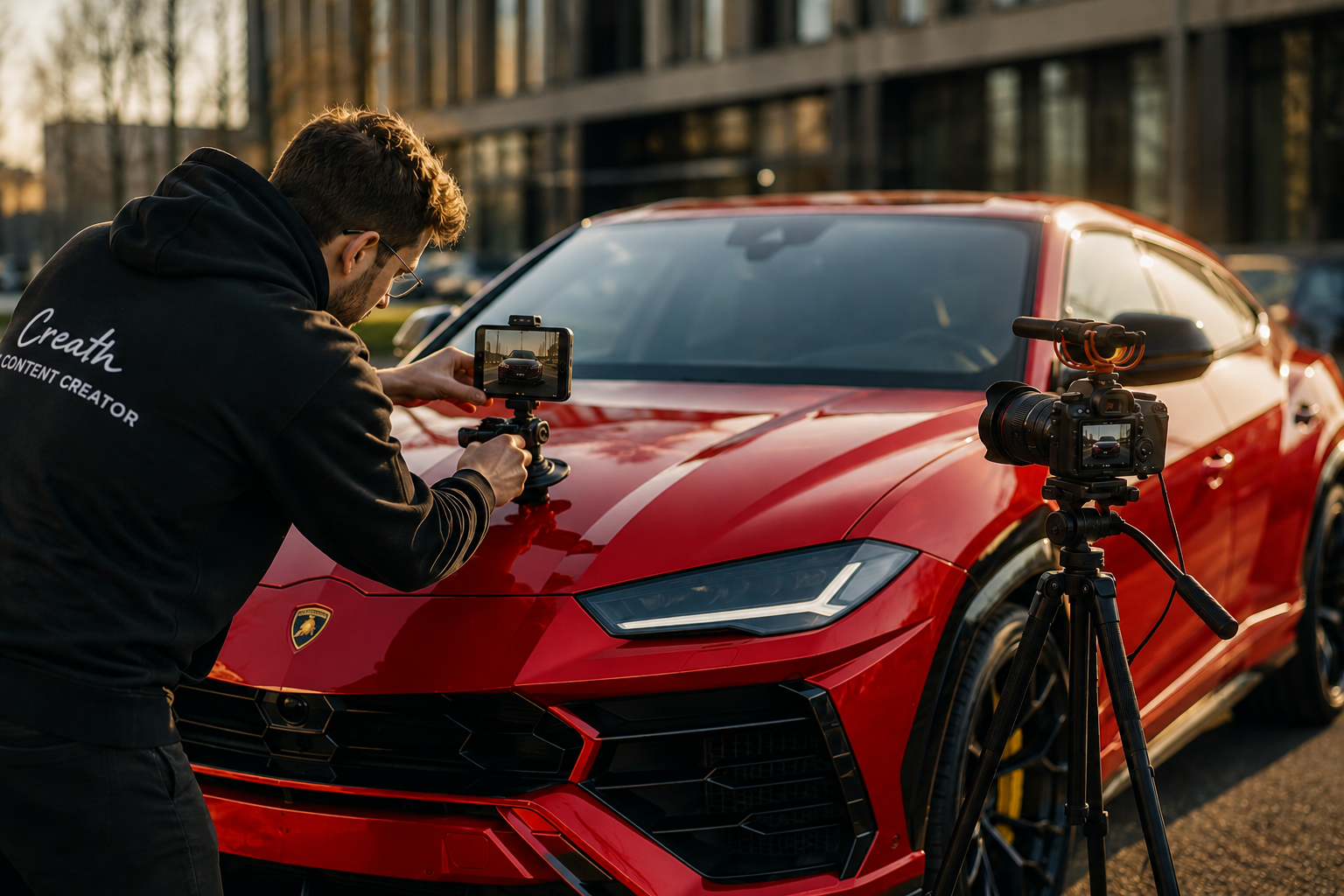
Here's how every serious UK car YouTube channel starts: someone who loves cars, a camera they already own, and the quiet realisation that they can't exactly review the car in the driveway. The barrier to building a car YouTube channel isn't talent. It isn't equipment. It's access.
The good news is that the UK has more ways to legally, affordably, and professionally access vehicles for YouTube content than most creators realise. From hourly car clubs that cost less than a coffee every ten minutes, to specialist production hire companies that supply Ferraris and Lamborghinis to professional shoots, the infrastructure exists. You just need to know which model fits your channel, your budget, and your content type.
This guide covers all of it.
Can You Hire a Car Specifically for YouTube Content in the UK?
Yes — but the answer has some important nuance depending on the type of hire and the nature of your content.
Standard commercial car hire (from major rental companies) is provided for driving, not specifically for filming. Most standard hire contracts don't explicitly prohibit filming the vehicle from outside, but they don't grant commercial permissions either. If your YouTube channel is monetised and you're featuring a hire car prominently, you're operating in a grey area that the standard contract doesn't address.
Specialist production and filming hire is explicitly designed for exactly this purpose. Several UK companies — and dedicated production divisions of larger hire groups — specifically cater to TV, film, music video, and YouTube shoots. These bookings come with the correct permissions, understood usage terms, and often logistical support for filming days.
Peer-to-peer platforms (where you hire a car directly from its owner) often have more flexible terms regarding filming, particularly if you're transparent with the owner about your intentions.
The practical advice: be transparent with your operator. Most hire companies are accommodating when approached directly about content use. Problems arise when creators film extensively without declaring intent and operators later see their vehicle prominently featured in commercial content they didn't agree to.
The Different Car Hire Models for UK YouTube Creators
Different YouTube formats require different access models. Here's how each works:
1. Standard Daily/Weekly Hire
The most familiar model. Book a car for a day or several days, pay a daily rate, return it at the end.
Best for: Road trip content, lifestyle vlogs, longer-format reviews where you need extended time with the vehicle.
Considerations: Most appropriate for factual content rather than commercial brand-integrated videos. Notify the operator you're filming; get permission in writing where possible. Don't expect to feature the hire company's branding without separate agreement.
Cost range: £30–£200/day for standard vehicles; £400–£2,000+/day for prestige and supercar hire
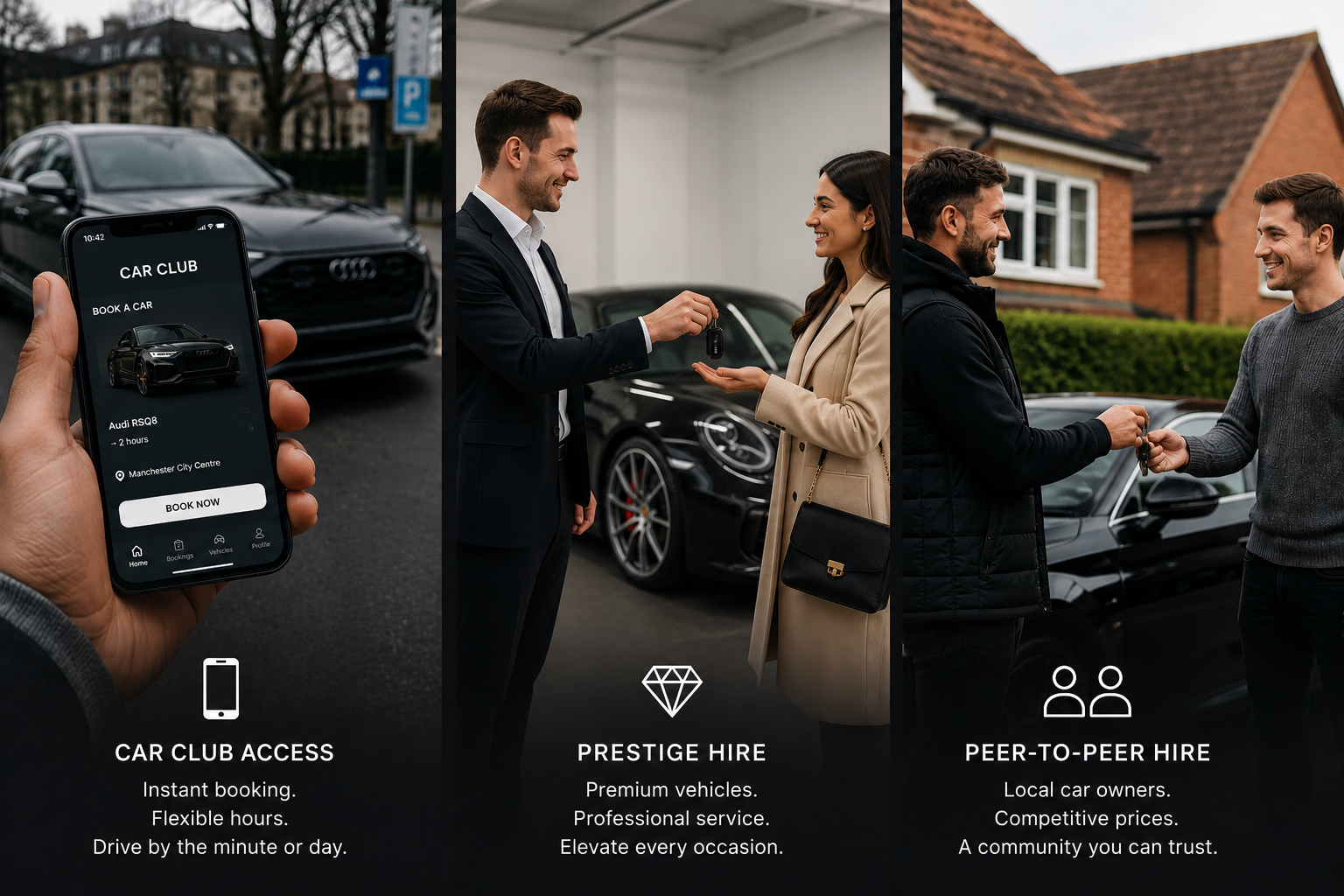
2. Car Club / Hourly Hire
Car clubs offer vehicles available by the hour or day, accessed via an app. The car is parked near you, you book it, unlock it with your phone, and return it to the same spot.
Best for: Short-form content, B-roll segments, quick walk-arounds, "day in the life" content where you need a vehicle for a few hours rather than a full day. Also useful for comparison content — you can book two or three different cars across a single day with multiple operators.
Cost range: From approximately £5–£15/hour for city cars; premium cars available on some platforms at higher hourly rates
The limitation: Car club vehicles are shared and maintained for practicality, not presentation. They won't have the visual quality of a prestige hire car.
3. Peer-to-Peer Car Sharing Platforms
Platforms where private car owners list their vehicles for hire. Think the Airbnb model applied to cars.
Best for: Accessing unusual or specific models that standard hire fleets don't stock. Classic cars, interesting modifications, rarer vehicles. Content that benefits from the owner's story and enthusiasm.
Considerations: Always communicate your content intentions to the owner before booking. Most private owners are enthusiastic about their cars being featured on YouTube if approached respectfully. Some will actively collaborate.
Cost range: Varies widely — market-rate pricing per day, often competitive with standard hire for similar vehicles
4. Specialist TV, Film, and Production Hire
The most appropriate model for commercial and professional YouTube content. These companies understand production schedules, provide correct usage permissions, and have fleets maintained to camera-ready standards.
Best for: Monetised YouTube channels producing commercial content, brand-integrated videos, music video productions, any shoot where the hire company's permission to feature their vehicles in commercial content matters.
What specialist production hire offers:
- Explicit permission for commercial filming
- Vehicles prepared to a standard appropriate for camera
- Experienced teams who understand production logistics (delivery timing, positioning, lighting requirements)
- A wide range of vehicles available — from hero supercars to background vehicles
Cost range: Varies by vehicle and duration; production hire often comes with day-rate pricing rather than standard hire rates
5. Car Subscriptions
Monthly or quarterly access to a vehicle through a subscription service. You pay a fixed monthly fee covering insurance, servicing, and delivery of a new vehicle.
Best for: Channels producing regular content with the same vehicle — a series, a long-term test, a seasonal road trip. The subscription model allows you to build a narrative around a specific car over weeks or months rather than a day.
Cost range: Approximately £400–£1,500/month depending on vehicle type; performance and luxury models at the higher end
Insurance and Commercial Use: What You Need to Know
This is the most important practical section for any creator who wants to avoid problems.
Standard hire insurance covers you to drive the car. It doesn't explicitly cover commercial filming use. For most creators producing non-monetised, low-key content, this hasn't been a practical issue. For channels with significant monetisation, brand partnerships, or high-profile commercial use, the position is more complex.
Key questions to clarify before filming:
- Does the hire contract include any language about commercial use or media production?
- Will the hire company's logos or vehicle appear prominently in commercial content (monetised videos, sponsored content)?
- Is the content for a brand campaign or purely editorial?
The safest approach: Contact the hire company directly, explain your content plans, and ask for written confirmation that filming is permitted for your intended use. Most professional operators are accommodating — they often appreciate the organic promotion.
Specialist production hire companies handle all of this by default. Their contracts include commercial filming permissions as standard.
Do You Need Permission to Show Hire Company Logos?
Generally, yes — for commercial content. Logo visibility in commercial productions (sponsored videos, brand campaigns) typically requires explicit permission from the brand.
For organic YouTube content (reviews, vlogs, road trips without commercial sponsorship), incidental logo visibility is generally considered fair use under UK copyright principles. The car's badging — Ferrari's Prancing Horse, Lamborghini's bull — is a factual element of describing the vehicle, not commercial endorsement.
For branded partnerships or sponsored content where the hire company is a featured element, get written permission. It's a simple process and most companies are receptive.
Supercars and Luxury Cars for YouTube Reviews
The most popular YouTube car content involves supercars — and the UK supercar hire market makes this genuinely accessible for creators at various budget levels.
| Vehicle Type | Best YouTube Format | Approx. Day Rate |
|---|---|---|
| Entry-level exotic (Audi R8, Porsche 911) | Reviews, comparison videos | £500–£900 |
| Mid-range supercar (Ferrari 488, Lamborghini Huracán) | Hero content, road trips | £900–£1,600 |
| Flagship exotic (McLaren 720S, Lamborghini Aventador) | Bucket-list content, events | £1,400–£2,500+ |
| Ultra-luxury (Rolls-Royce, Bentley) | Lifestyle, luxury review | £800–£1,500 |
| Luxury SUV (Range Rover SVA, Lamborghini Urus) | Comparison, family content | £600–£1,200 |
The return on investment calculation for supercar hire for YouTube is different from hire for personal enjoyment. A well-produced Lamborghini Huracán review video can generate views, ad revenue, and subscriber growth over months and years. The hire cost is a production expense against those returns — and one that many successful UK car channels have found very favourable.
Hiring Multiple Vehicles for Comparison Videos
Comparison videos are consistently among the highest-performing formats in UK automotive YouTube. The "X vs Y" format works because it serves genuine audience intent — people trying to decide between two cars, or simply enjoying the drama of a direct contest.
Hiring two vehicles simultaneously for a comparison shoot requires:
- Coordinating two operators (unless one operator has both vehicles) — brief both on the same shoot day logistics
- Scheduling enough time — a proper two-car comparison with driving footage, static shots, and in-car content typically requires a full day minimum
- Planning your location — you want one location that works for both vehicles, ideally with some variety (urban, open road, scenic)
- Having a second driver — for rolling comparison shots, you need someone to drive one car while you're in the other
Some specialist production hire companies can supply multiple vehicles from their own fleet, which simplifies coordination significantly.
Can You Film on Track or Private Roads?
The default answer: no. Standard hire contracts almost universally prohibit track use, and this restriction typically extends to private roads and off-road terrain.
For track content specifically:
- Track day hire exists as a separate product — specialist operators offer vehicles specifically for circuit use with appropriate insurance
- Standard hire cars on track voids the insurance and breaches the hire agreement — this isn't ambiguous
- Some specialist production hire can accommodate controlled private road shooting with appropriate permissions — but this requires explicit prior arrangement
If track content is part of your YouTube plan, work with operators who specifically offer track-capable hire. This is a legitimate product; it just requires the right booking.
Can You Add Wraps, Decals, or Branding to a Hire Car?
No — with rare exceptions.
A hire car cannot be wrapped, painted, decaled, or otherwise permanently or semi-permanently modified without explicit operator permission, which is almost never granted for standard hire.
Temporary, non-adhesive elements (magnetic signs, suction-cup mounts) are sometimes permitted — confirm before fitting anything to the vehicle.
Specialist production hire for brand campaigns may include provisions for temporary branding within the production agreement. This requires negotiation at the booking stage, not improvisation on the day.
Age and Licence Requirements for YouTube-Relevant Vehicles
The standard supercar hire age and licence requirements apply whether you're hiring for personal use or content creation. Being a YouTube creator doesn't change the operator's insurance criteria.
| Vehicle Type | Typical Minimum Age | Licence Requirement |
|---|---|---|
| Standard and economy cars | 21 | Full licence, 1+ years |
| Premium and executive | 21–25 | Full licence, 2+ years |
| Sports cars and exotics | 25 | Full licence, 2–5+ years |
| Flagship supercars | 25–30 | Full licence, 3–5+ years |
For content creators specifically: your age, licence status, and driving record are evaluated the same as any other hirer. Having a YouTube channel with a million subscribers does not change your minimum age from 23 to 21.
The Best UK YouTube Car Channel Formats and Their Ideal Hire Models
| YouTube Format | Best Access Model | Notes |
|---|---|---|
| Full day review (single car) | Standard prestige hire (1 day) | Plan shots in advance; maximise the hire window |
| Comparison video (2+ cars) | Standard hire or specialist production | Coordinate timing carefully |
| Road trip series | Subscription or multi-day hire | Continuity across multiple episodes |
| Reaction / experience video | Standard supercar hire (1 day) | The first-drive format works well with hire |
| Music video / brand content | Specialist production hire | Requires commercial filming permissions |
| Weekly car content (ongoing) | Car subscription | Predictable cost, consistent vehicle access |
| Budget car content | Car club / hourly | Low cost, flexible, accessible |
| Classic car content | Peer-to-peer or specialist classic hire | Unusual vehicles not in standard fleets |
How UK Creators Use Hire Cars to Build Channels
The pattern across successful UK automotive YouTube channels is consistent: the most sustainable model is a combination of hire (for aspirational hero content), press loans from manufacturers or dealers (for current model reviews), and where possible personal vehicles for ongoing coverage.
For channels starting out, the hire model is the most practical. A well-planned single-day hire of a genuinely exciting car — combined with good filming preparation — can produce enough content for multiple videos, including a long-form review, short-form cuts for Shorts and social, and behind-the-scenes content about the hire experience itself.
Maximising a single hire day:
- Plan every shot in advance — don't arrive at the car and improvise
- Film your A-roll (main review content) first, when you have the most energy
- Get multiple angles of every driving sequence — you'll use more than you think in the edit
- Film the handover — the excitement of collecting the car is genuinely engaging content
- Return the car with 30 minutes to spare — rushing the last shots under time pressure is avoidable
Final Thoughts: Access Is the Only Thing Stopping You
The UK car content ecosystem has never been more accessible for creators. The full spectrum from a £5/hour car club booking to a £2,000/day Lamborghini production hire is available — legally, professionally, and increasingly with explicit creator-friendly terms.
The difference between a good automotive YouTube channel and an outstanding one is rarely equipment or editing skill. It's access to interesting cars and the ability to present them compellingly. The hire models in this guide solve the first half of that equation. The rest is up to you.
Start with what you can afford. Be transparent with your operators. Build the content properly. The audience will follow.
Ready to find the right car for your next YouTube shoot? Compare vehicles and prices from hundreds of hire partners across the UK with Autofusion — and book the car that makes the video.