


Published 16 May 2026
Our methodology focuses on accuracy first.
All information is researched using manufacturer data, official industry guidance, and trusted automotive sources. Where relevant, content is cross-checked against real-world vehicle maintenance practices and common customer enquiries to ensure it is both practical and accurate. Our content is reviewed regularly and updated to reflect changes in regulations, industry standards, and best practices.
There's a version of corporate car hire that most people think they understand — a company account at a rental firm, employees booking cars for business trips, someone in procurement complaining about the receipts. Functional, necessary, unexciting.
And then there's what corporate car hire actually looks like when it's managed well: a structured vehicle programme that spans everything from the airport run your regional sales rep makes twice a week to the electrified salary-sacrifice scheme that became the company's most popular employee benefit. A system that's integrated with expense management, reduces grey-fleet liability, and positions the business correctly in front of the clients who see what employees drive.
The UK corporate car hire market covers an enormous range of products — from ad-hoc business rental through a corporate account, to structured Business Contract Hire for company car fleets, to EV salary-sacrifice schemes that have become one of the fastest-growing employee benefits in the country. Understanding how these products work, when each one is the right solution, and how to set one up is genuinely useful for anyone managing business travel, HR, or procurement in a UK company.
This guide cuts through the options clearly.
The Corporate Car Hire Landscape: Three Distinct Products
Before diving into specifics, it helps to understand the three core products that fall under "corporate car hire" — because they serve quite different purposes and are often conflated.
1. Short-Term Business Rental (Days to Weeks) The ad-hoc hire model. An employee needs a car for a business trip, project, or site visit. Booked through a corporate account with a rental firm, typically billed centrally. Vehicles range from economy to executive depending on the trip and traveller.
2. Business Contract Hire (BCH) — 2–4 Year Leases The company car model. Fixed monthly payments for specific vehicles over a defined term, used as ongoing company cars for employees. VAT-efficient, off-balance-sheet, with maintenance optionally included. The structured fleet choice.
3. EV Salary Sacrifice Schemes The modern hybrid model. Employees lease fully electric vehicles through a salary-sacrifice arrangement, benefiting from low Benefit-in-Kind (BiK) tax and National Insurance savings. Employer and employee both benefit. The fastest-growing segment in the UK corporate car market right now.
Each product solves a different problem. The mistake most companies make is using one for situations that another serves better.
Short-Term Corporate Car Hire: The Business Account Model
For companies whose car needs are genuinely ad-hoc — occasional business trips, visiting clients, airport pickups — the short-term rental model with a corporate account is the right structure.
How a corporate account works:
A corporate account with a major rental provider (Enterprise, Hertz, Sixt, Budget, etc.) gives the company:
- Negotiated rates below consumer pricing, based on volume commitment
- Central billing — all hires invoiced to the company, reducing the expense management burden on employees
- Authorised driver lists — the company specifies which employees can hire on the account
- Reporting and analytics — monthly or quarterly data on spend, mileage, and utilisation by employee or department
The booking process is simpler than personal rental: employees book via the corporate portal, select from the approved vehicle categories, and collect at the specified location. No personal credit card required for deposit in most corporate account structures — the liability sits with the business.
Vehicle range for corporate short-term hire: From economy cars for budget-conscious trips to executive saloons (Mercedes C-Class, BMW 3 Series) for client-facing travel, and SUVs or people carriers for groups. The range available at any given location varies by provider and region.

Business Contract Hire: The Company Car Fleet
For companies with employees who need vehicles on an ongoing basis — sales teams, field engineers, senior executives — Business Contract Hire (BCH) is the standard fleet structure in the UK.
How BCH works:
- The finance provider owns the vehicles
- The company pays a fixed monthly rental over an agreed term (typically 24–48 months)
- At the end of the contract, vehicles are returned; the company is not exposed to residual value risk
- Maintenance can be included or handled separately
The tax and accounting advantages:
For VAT-registered businesses, BCH is financially structured in ways that most other vehicle arrangements aren't:
- 50% of VAT on car rentals is reclaimable (100% if the car is used exclusively for business, which is rare but possible)
- 100% of VAT on maintenance packages is reclaimable
- Vehicles remain off the balance sheet — they don't appear as assets or liabilities in the company accounts, which is relevant for debt covenants and investor presentations
- Corporation tax: For cars with low CO₂ emissions, capital allowances can be very favourable
The practical process:
To set up a BCH fleet, providers typically require:
- Company name, registered address, and Companies House registration number
- Date established and date of latest filed accounts
- Director details for credit assessment
- Estimated annual mileage per vehicle (mileage bands are agreed upfront — getting this right matters, as excess mileage is charged at the end of the contract)
Once approved, vehicles are delivered to business premises or, with director authorisation, to employees' home addresses.
EV Salary Sacrifice: The Modern Corporate Car Opportunity
The fastest-growing corporate vehicle scheme in the UK right now isn't a luxury perk — it's a financially structured arrangement that benefits both employer and employee in measurable ways.
How salary sacrifice works: An employee agrees to sacrifice a portion of their gross salary in exchange for a leased electric vehicle. The employer arranges the lease; the employee's effective salary is reduced before income tax and National Insurance are calculated. Both parties benefit:
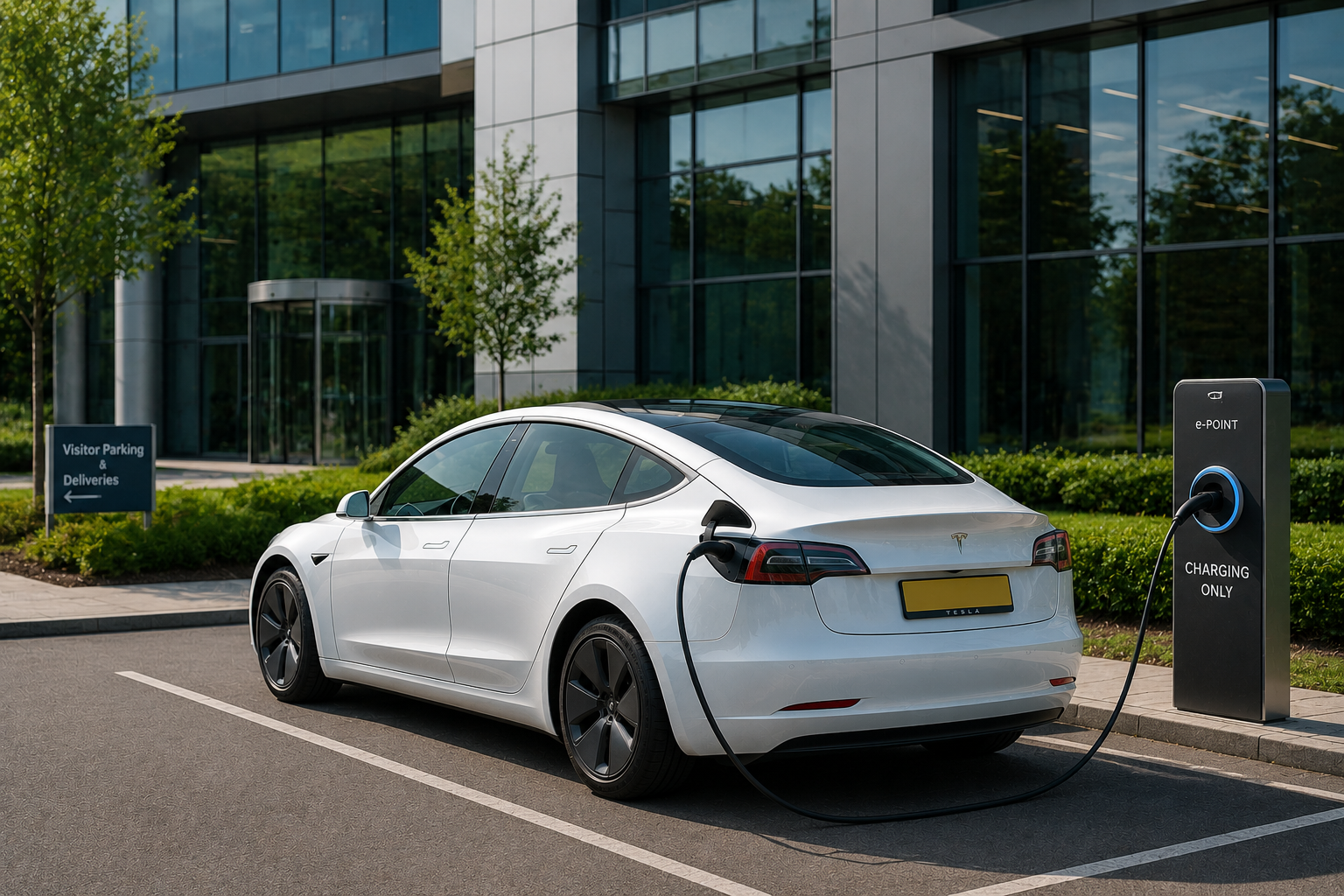
- Employee: Lower income tax on the sacrificed amount, significantly lower NI contributions, and — crucially — the Benefit-in-Kind tax rate on a fully electric vehicle is 2% of list price (as of 2026). On a Tesla Model 3 worth £40,000, this means the employee pays BiK tax on £800 per year. In the 40% tax bracket, that's £320/year in BiK tax
- Employer: National Insurance savings on the sacrificed salary amount (approximately 13.8%), plus the ability to offer a premium employee benefit at minimal direct cost
Why EVs make salary sacrifice so compelling:
The 2% BiK rate on EVs versus 25–37% on petrol/diesel equivalents creates a tax position that makes even expensive EVs surprisingly affordable through salary sacrifice. The Porsche Taycan, Tesla Model 3, BMW i4, and Audi Q6 e-tron have all become popular salary sacrifice vehicles precisely because the tax maths makes them competitive in total cost with much cheaper combustion cars.
Which Product Is Right for Your Company?
| Situation | Recommended Product | Why |
|---|---|---|
| Occasional business trips, no ongoing need | Short-term rental, corporate account | Flexibility, no commitment, central billing |
| Sales or field team needing ongoing vehicles | Business Contract Hire (BCH) | Fixed costs, VAT efficiency, off-balance-sheet |
| Senior executives with permanent company cars | BCH with maintenance included | Premium vehicles, predictable cost, low admin |
| Employees who want EVs and tax efficiency | EV Salary Sacrifice | BiK and NI savings for employer and employee |
| Project-based needs (3–12 months) | Flexi-lease or medium-term rental | Bridges gap between daily hire and long-term lease |
| Large fleet (50+ vehicles) | Fleet leasing with management services | Volume pricing, telematics, centralised management |
Corporate Car Hire for Visiting Clients and Airport Transfers
One specific use case that sits within corporate car hire but deserves its own mention: providing transport for visiting clients, inbound executives, and senior guests.
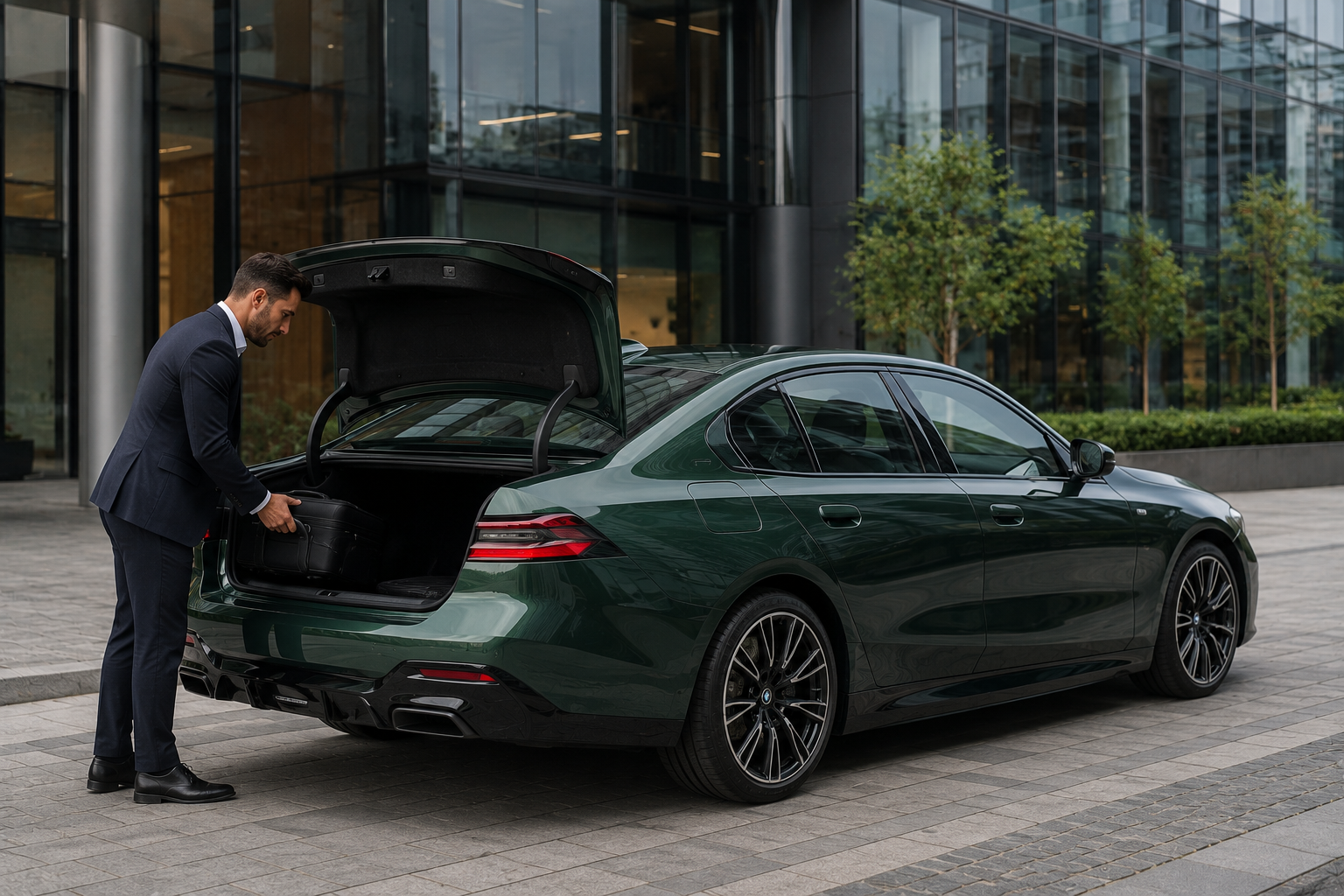
The standard for a meaningful client visit is a chauffeur-driven executive saloon — Mercedes S-Class, BMW 7 Series, or equivalent — meeting the visitor at the airport with a name board, handling luggage, and delivering them to the meeting or hotel without the friction that taxis, ride-hail, and self-directed transport create.
Several corporate account providers include chauffeur services alongside their self-drive fleet. Enterprise, in particular, coordinates executive transport as part of its broader corporate mobility offering. For companies that want to ensure consistency — that every senior visiting client receives the same standard of transport — this is worth building into the corporate travel policy rather than leaving to ad-hoc arrangements.
The Electric Transition: Corporate Car Strategy for 2026
The UK's ZEV (Zero Emission Vehicle) mandate and the 2030 end-of-sale date for new petrol and diesel cars are reshaping the corporate fleet market faster than most companies expected. Several factors are accelerating the transition:
The tax position is compelling. The 2% BiK rate on EVs is not projected to remain this favourable indefinitely — as EV adoption increases, rates will likely rise. Companies moving their fleets to EVs now are locking in the current advantageous rates while they last.
The salary sacrifice uptake is significant. Companies that have launched EV salary sacrifice schemes report strong employee uptake, particularly among employees in higher tax brackets where the savings are most meaningful.
Fleet charging infrastructure is increasingly manageable. The assumption that EV fleets require extensive on-site charging infrastructure has been replaced by a more pragmatic reality: home charging for employees (OZEV grants are available to cover home charger costs), a growing public rapid charging network, and workplace charging where the footprint justifies it.
The SUV-to-EV shift is underway. The most popular corporate fleet vehicles are increasingly plug-in hybrids and full EVs: Tesla Model 3, BMW i4, Audi Q6 e-tron, Volvo EX40, and at the premium end, the Porsche Taycan.
Setting Up Corporate Car Hire: The Practical Steps
For a company starting from scratch with corporate car hire:
For a short-term rental account:
- Contact major rental providers (Enterprise, Hertz, Sixt, Budget) and request a corporate account application
- Provide company registration details, estimated annual volume, and main user locations
- Negotiate rates based on volume commitment
- Define the approved driver list and driver policy
- Set up central billing and integrate with your expense management system
For Business Contract Hire:
- Define vehicle requirements by role (sales reps, executives, field staff)
- Set annual mileage assumptions — be realistic; underestimating creates excess charges
- Decide on maintenance inclusion (recommended for simplicity)
- Obtain quotes from BCH providers and compare total cost over term
- Submit credit application with company financials
- Sign agreements and arrange delivery
For EV Salary Sacrifice:
- Engage an employee benefits platform or fleet leasing provider with salary sacrifice capability
- Model the financial impact for employer and employees at various salary levels
- Communicate the scheme to employees with specific examples (the £320/year BiK tax example for a Tesla Model 3 is genuinely compelling)
- Set up the scheme structure with HR and payroll
- Define which vehicles are available and any company contribution
Before You Set Up a Corporate Account: Checklist
- ✅ Does the provider offer the vehicle categories your employees actually need?
- ✅ Is central billing available, and how does it integrate with your finance system?
- ✅ What's the minimum commitment for negotiated rates?
- ✅ Are approved driver lists and authorisation managed online?
- ✅ For BCH: what are the end-of-contract condition standards and handback process?
- ✅ For salary sacrifice: does the scheme platform handle the payroll deduction calculation and NI savings reporting?
- ✅ What reporting is available — utilisation, spend by department, emissions data?
Corporate car hire in the UK has evolved considerably beyond the standard rental account. The combination of BCH, salary sacrifice, and flexible short-term rental gives companies a genuinely sophisticated toolkit for managing employee mobility — with real tax efficiency, meaningful sustainability benefits, and a level of employee satisfaction that the grey-fleet and personal-car-with-mileage-claims model can't match.
The companies that manage this well treat it as a strategic tool rather than an administrative overhead. The difference in both cost and culture is measurable.
Looking to compare luxury and executive car hire options across the UK for corporate travel and business use? Autofusion lets you browse and compare prestige and executive car hire from hundreds of rental partners nationwide. Explore corporate car hire across the UK with Autofusion today.